Softball Positions Explained: What Each One Actually Does
There are nine softball positions on defense, and each one is numbered — pitcher is 1, catcher is 2, and the numbers run around the infield and out to right field. Those numbers aren’t trivia. They’re the scorekeeping system, and once you know them you can read a scorebook, understand what “6-4-3” means, and follow what a coach is telling your kid.
This is the plain version: what each position is actually responsible for, what it demands from a player, and what goes wrong when the fit is off.
Jump to a section
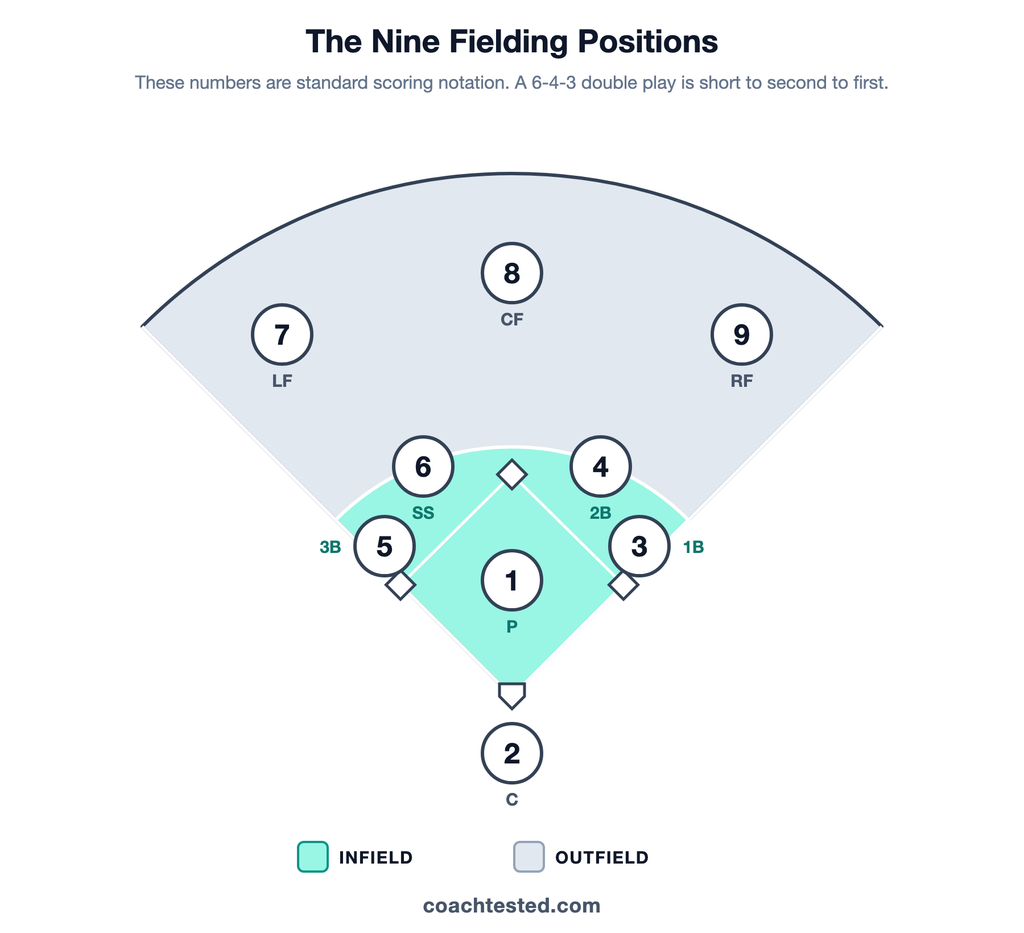
The nine softball positions, in order
| # | Position | Short form |
|---|---|---|
| 1 | Pitcher | P |
| 2 | Catcher | C |
| 3 | First base | 1B |
| 4 | Second base | 2B |
| 5 | Third base | 3B |
| 6 | Shortstop | SS |
| 7 | Left field | LF |
| 8 | Center field | CF |
| 9 | Right field | RF |
The order trips people up. Third base is 5 and shortstop is 6, even though shortstop stands between second and third. It’s a historical quirk, not a logic you need to reconstruct — just learn it.
So a “6-4-3 double play” is shortstop to second base to first base. A “5-3 putout” is third base fielding it and throwing across. Once the numbers click, a scorebook stops being code.
The battery
Pitcher (1). Every pitch starts here, and at youth level the pitcher determines more about how a game feels than any other player. She also has to field: comebackers, bunts, covering first on a ground ball to the right side, and backing up throws home. A pitcher who freezes after releasing the ball is a defensive hole in the middle of the diamond.
Catcher (2). The hardest job to fill and the one with the longest list of duties. She receives every pitch, blocks what gets past, throws out runners, fields bunts and pop-ups, and is the only player on the field looking at everybody else — which makes her the one who should be directing traffic on cutoffs and force plays. The gear is hot and the squatting is relentless. Teams that find a kid who genuinely wants to catch generally build around her.
The infield
First base (3). Receives throws from everywhere, so footwork around the bag matters more than range. She has to pick short-hops out of the dirt, stretch without coming off the base early, and know when to hold a runner. Teams often put a tall player here because the reach helps, but soft hands help more.
Second base (4). Shorter throw to first than shortstop, so it asks less of the arm — which is why it’s often where a developing infielder starts. It asks plenty of everything else: covering on steals, turning the pivot on a double play with a runner bearing down, and taking relay throws from right field.
Third base (5). The hot corner, and the name is earned. Right-handed hitters pull hard ground balls down the line and the reaction time is the shortest on the field. Needs a strong arm for the long throw across the diamond, and the nerve to stay in front of a ball that’s coming fast.
Shortstop (6). The most range of any infielder, the most balls hit her way, and the longest routine infield throw. She covers second on steals from one side, takes relays from left and center, and is usually the infield’s organizer. In youth ball this is almost always where the best infielder goes.
The outfield
Left field (7). The most balls of the three in youth softball, because the majority of hitters are right-handed and pull. The throw to third is short enough to matter — a left fielder who gets rid of it quickly keeps a double from becoming a triple.
Center field (8). The one who gets to call everybody else off. The most ground to cover, priority on any ball she can reach, and the job of waving the corners away before two players arrive at the same spot at full speed. Reads and closing speed matter more here than arm strength.
Right field (9). The longest throw on the field, all the way to third, which is why the “put her in right field” instinct from baseball doesn’t transfer cleanly. At younger ages fewer balls go there. As hitters mature and start going the other way, that stops being true, and a right fielder who can’t throw becomes a problem.
If you’re sitting in the bleachers, the position that will surprise you is second base. It looks like the easy one — the short throw, the spot you put a kid who can’t reach first from deep short. Then you watch her turn a double play with a runner bearing down on the bag, or take a relay from right field with her back to the play, and you realize she’s doing more thinking per pitch than almost anyone out there.
The rover, and why it isn’t in the rulebook
If your daughter comes home saying she played rover, she isn’t making it up. But here’s the thing worth knowing, because nobody tells parents this:
The word “rover” does not appear in the rulebook. Neither does “short fielder.”
It appears nowhere in the USA Softball Official Rulebook, and nowhere in the USSSA fastpitch rules. It’s a term leagues and coaches use. It is not a position either national body recognizes.
What the rulebooks actually say is this. Fastpitch is nine fielders, period: pitcher, catcher, first, second, third, shortstop, and three outfielders. The variations you’ll hear about — DP/Flex, an Extra Player — add people to the batting order, not to the field. A junior fastpitch team using an EP has ten batting and nine on defense.
Slowpitch does use ten — but the tenth isn’t a rover roaming behind the infield. The rulebook splits the outfield into four and names them: left field, left center, right center, right field. It’s an extra outfielder with a job description.
And where USSSA allows extra fielders in the youngest divisions, the rule comes with a leash: up to ten in the field, but six in the infield including the catcher, and the rest in the outfield.
So here’s the rule of thumb that actually helps you:
Wherever a tenth fielder legitimately exists, the rulebook makes her an outfielder — or caps the infield at six. If your daughter’s “rover” is standing on the infield dirt, that’s your league’s own local rule, not a national one.
Which is fine. Leagues amend things constantly, usually to get more kids on the field, and that’s a good instinct at young ages. But it means the only place to find out what your rover is actually supposed to do is your own league’s rules, not a general softball article — including this one.
What a utility player actually is
A utility player isn’t a position. It’s a description of a player who can competently fill several, and it’s one of the most undervalued things a youth team can have.
It is not the same as “doesn’t have a position yet.” A utility player is someone who can be dropped into three or four spots without the defense getting worse — which means she’s learned the footwork and the responsibilities of each, not just stood there.
Coaches love them for a straightforward reason: rosters fall apart. Somebody is sick, somebody is on vacation, somebody fouls a ball off her foot in the third inning. The team with two genuine utility players handles that. The team where every kid knows exactly one spot does not.
If your daughter is being moved around a lot, that is worth hearing as what it usually is — a sign she’s trusted in more than one place, not that she’s been left without a home.
How softball positions actually get assigned in youth ball
Honestly? Less deliberately than parents imagine.
At rec level, coaches are often assigning positions in the first week, from almost no information, with a roster they didn’t pick. The first few games are data collection. Early assignments get made on arm strength, attention span, and who is willing to catch — and they change.
At higher levels it gets more deliberate, but the logic stays similar: the best infielder goes to shortstop, the best arm ends up at third or catching, the fastest player goes to center, and everything else is fitted around those.
What this means for a parent is that a position in April is not a verdict. It’s a starting guess, and the kid who ends up somewhere else in July usually got there by getting better, not by being demoted.
And a move is often the making of a kid. The girl who gets taken out of the infield because the ball is coming too fast at her spends a season in the outfield learning to read a ball off the bat, comes back with hands that aren’t scared anymore, and ends up somewhere better than where she started. That happens constantly. It almost never looks like good news in April.
Where to start if you’re assigning them
Two things matter more than the rest: put your most reliable glove where the most balls go, and put your best arm where the longest throw is. In youth softball that usually means shortstop and third base, in that order.
If the question you actually have is where to put a player who’s still developing, that’s a different decision with its own logic, and the live piece on where to hide your weakest fielder works through it properly.
Bottom line
Nine softball positions, numbered 1 through 9, each with a job that’s more specific than “stand there and catch it.” The rover is real but only in some formats. The utility player isn’t a position at all — she’s the kid who keeps your season from falling apart in week six.
And the position your daughter is playing right now may not be the position she’ll be playing in two years.