Running a 5-1 Without a Libero
Almost every 5-1 resource you’ll find assumes you have a libero. The diagrams label a spot “L” and move on.
That’s a problem if you coach rec ball, a PE class, a small school, a young team, or any roster where nobody is a libero yet. Running a 5-1 without a libero is entirely doable, but players and coaches in exactly that situation go looking for help and find nothing that matches the court they’re standing on.
So here is the translation.
The one-sentence answer
Wherever a diagram says libero, read “back-row middle.”
That’s genuinely it. The libero’s job in a 5-1 is almost always to take over for whichever middle has rotated behind the attack line. Take the libero away and the middle does that job herself.
The rotation order doesn’t change. The overlap relationships don’t change. Your setter’s two bases don’t change. Every 5-1 diagram on the internet still applies to your team — you just read one label differently.
If you’ve been avoiding those resources because they don’t match your roster, stop. They match.
What actually changes
Five things, and they’re worth planning for beforehand.
Your middle is now in serve receive. She’s typically the player with the fewest passing reps on your roster, and she’s now taking serve in three of the six rotations. Expect that to be your weak seam and arrange around it — put her where the fewest balls go, not where the diagram happens to show a libero standing.
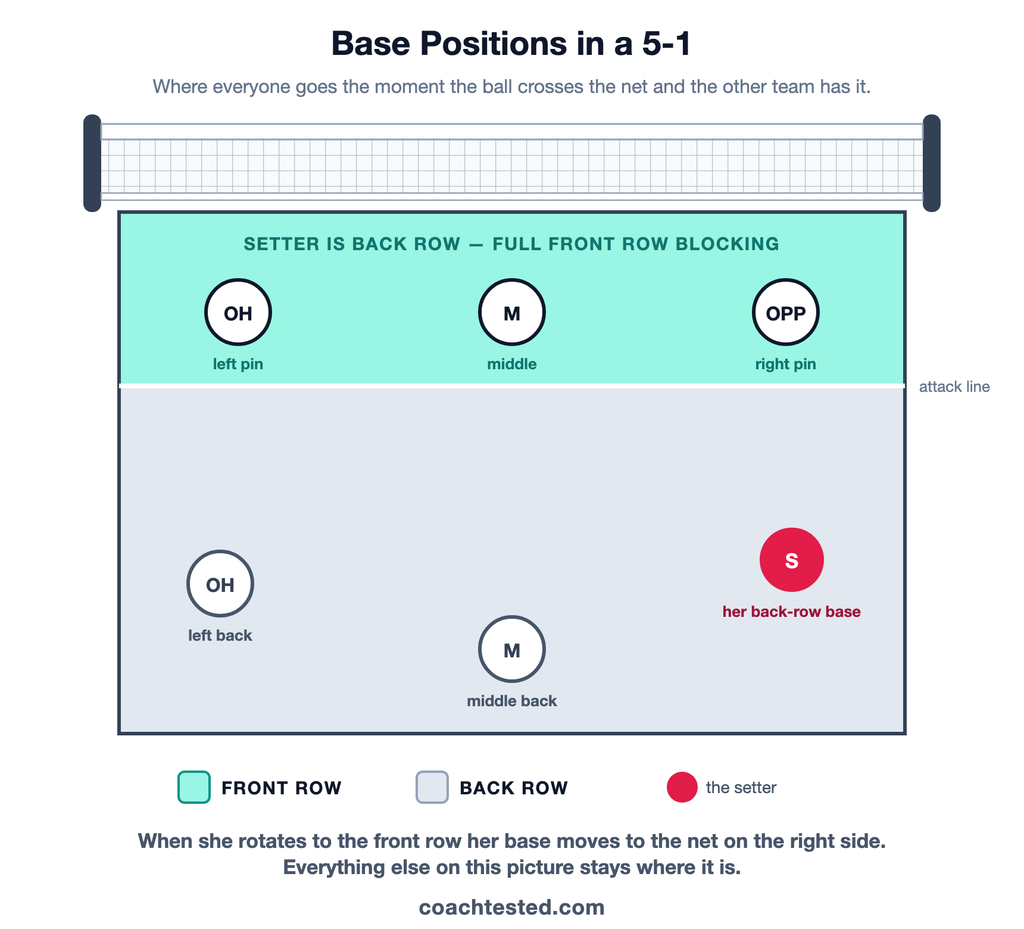
You’re a passer short, so you’ll borrow one from the front row. Your setter doesn’t pass. If your middle isn’t ready to either, you’re thin. The usual answer is to bring your right side into the passing pattern. That works, and good teams do it on purpose, but the cost is that she’s passing first and approaching second, so her attack arrives late.
There’s no free swap any more. This is the one that surprises people. A libero replacement is not a substitution — it doesn’t count against your limit, and you can do it all match as long as a rally is completed between replacements. Without a libero, getting your middle out of the back row costs a real substitution every single time.
Your limit depends on who sanctions your season: NFHS 18 per set, USA Volleyball 15, NCAA 15 in Division I and 18 in Divisions II and III. Do that arithmetic before you plan on subbing your middle out six times. And check it against the current book rather than what you learned; USAV raised its limit from 12 to 15 in the 2025-2027 cycle.
Your middle plays all six rotations. More court time, and much more running, for the player whose job is short explosive movement at the net. That workload shows up as fatigue late in a match, and fatigue can look like lack of effort. Take care not to misread it.
Your defense has a hole where your best defender used to be. The libero exists because back-row defense is a specialist skill. Without her you’re covering the same court with a player who has spent the season learning to block. Lower your expectations for digs and raise them for effort.
The moment this really hurts is when you watch a green middle get targeted by a good server and shank three in a row. You have to be ready to adjust fast to prevent the set from being a runaway loss as well as to keep your girls from deflating like punctured balloons.
The upside nobody mentions
I have seen middle school coaches choose to run without a libero in the interest of developing the defensive skills of the whole team. Not a bad choice for a developmental team.
One of the biggest issues with younger volleyball girls is getting them to see the court as “theirs” and every ball as “theirs.” When you introduce a libero, it can tunnel-vision girls who already are too siloed in what they perceive to be their job on the court.
They start making claims like “I don’t play back row” or “that’s not my ball” because it’s the libero’s ball. This is the opposite of what you want in your players and will hamstring them at higher levels.
It’s good to get young tall girls playing back row and making them work on their court IQ, getting the hard serves and being responsible for defense. This helps them get out of that silo mentality and learn to be in the rhythm of ball play, which they must do to succeed at higher-level volleyball. Plus, many middles do play a rotation in the back row after they serve, so they need to be well-equipped to play the position.
Your middle learns to pass and defend. Coaches who run a libero from the youngest ages sometimes end up with middles who have never developed a back row at all, players who are good at two skills and helpless at four. That limits them later, when a high school or club coach needs someone who can do more than block.
A season where your middle has to pass serve is a season she gets better at passing serve. That’s not a consolation prize. For a developmental team it may be worth more than the digs you gave up.
Everybody on your roster stays a six-position player. Nobody gets quietly written off as a front-row specialist at thirteen.
What to look for when you build toward one
Most teams eventually want a libero. When you’re choosing, the instinct is to pick your best athlete. That’s usually the wrong instinct.
Look for the player who reads a served ball early and talks. Anticipation and communication are the two things you cannot install in a season. You can teach a platform. You can teach footwork. You cannot easily teach the kid who is already moving before the ball is struck, or the one who calls “mine” loudly enough that nobody collides with her.
Height is close to irrelevant. Vertical is irrelevant. Willingness to hit the floor matters, but less than people think. The best defenders mostly aren’t diving, they’re standing in the right place early.
And she has to want the job. A libero never attacks, never blocks, never serves except in one rotation, and gets a jersey that announces she’s different. A player who resents that will be worse at it than a less gifted player who’s proud of it.
Most of the liberos on my teams are humble hard workers who build almost a second sense for the opponent’s next move.
Two rules that still apply if you pick up a libero mid-season
She may serve, but in one rotation only. This is true under all three American codes — USA Volleyball, NFHS and NCAA. You pick the slot and that’s the only one she serves from for the rest of the set. If you’ve heard the libero can’t serve at all, you’re thinking of FIVB international rules.
She can’t overhand finger-set from the front zone to a hitter who then attacks above the net. Two things people get wrong here. The fault belongs to the hitter, not to her — the whistle comes on the attack. And it applies only to an overhand finger action, so a bump set is unrestricted anywhere on the court. That’s why many teams simply teach her to bump-set anything inside the ten-foot line. From behind the attack line she can set however she likes and anyone can swing.
On how many liberos you may carry, the codes have just converged: all three now let you designate up to two per set, with only one on the court at a time. NFHS was the holdout at one until rule 6-4-2 changed for the 2026-27 season, so if you have an older rulebook or an older coach telling you one, that’s why.
Where to go from here
The rest of the system is unchanged, so any standard 5-1 resource applies to you as written — just read “back-row middle” wherever it says libero.
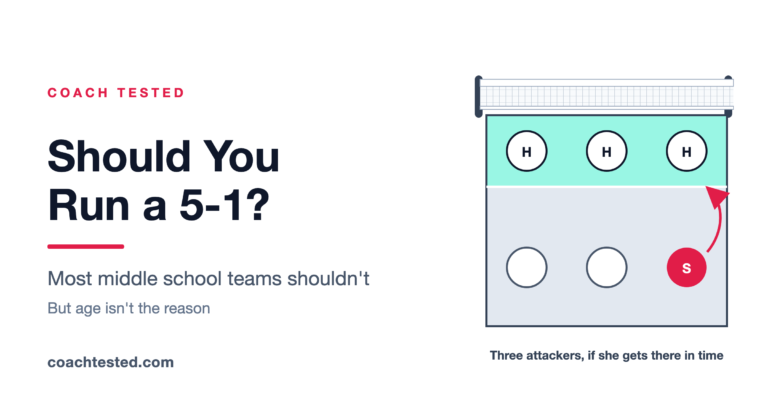
If you’re not sure a 5-1 is the right system for your roster in the first place, Should Middle School Teams Run a 5-1 rotation? works through the four questions that decide it, and running without a libero makes one of those questions harder to answer yes to, because you’re asking more of your passers.
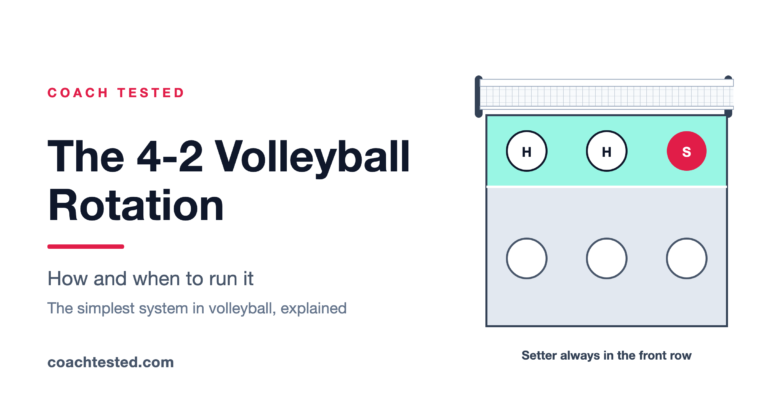
And if the honest answer is that your passing isn’t there yet, How to Run a 4-2 Volleyball Rotation is a better place to spend the season. A 4-2 with no libero is a much gentler ask than a 5-1 with no libero.

2 Comments
Comments are closed.