How and When to Run a 4-2 Volleyball Rotation (Complete Guide)
In a 4-2 volleyball rotation, the setter is always in the front row. You run two setters positioned opposite each other in the rotation, so one of them is always up front and ready to set while the other plays defense in the back row.
That single rule is the whole system. Four hitters, two setters, and a setter who never has to sprint from the back row to the net.
Who needs this: new coaches of young/beginner teams. Especially coaches who are overwhelmed by trying to do a lot of things at once and/or aren’t even sure what they should be doing. This rotation is simple and will get your team playing volleyball fast. Once you get this mastered or your team grows in skill you have a good foundation to move to a different rotation.
Jump to a section
What rotation should a young or beginner team run?
For most first-year programs, C teams, and middle school groups still learning to pass, the answer is a 4-2.
It has the fewest moving parts. The setter doesn’t release from the back row or need to worry about getting somewhere she isn’t basically already. Your players learn where to go, and when they don’t, you can see what went wrong.
It’s also the system you can coach while you’re still learning the sport yourself. A well-run 4-2 beats a badly run 5-1.
Not everyone agrees. Plenty of experienced coaches will tell you seventh grade is too old for a 4-2, and that a program building from scratch should start with the system it intends to finish with. They are probably right about their own rosters. I’ve written separately about whether a middle school 5-1 makes sense for your roster — the short version is that it depends on one player, not on grade level.
But the deciding factor isn’t grade level. It’s two things: whether your passers can deliver a ball to a target, and whether you have one player who can set from anywhere on the court. If the answer to either is no, run a 4-2 this season and build toward something else.
I’m running a 4-2 with my developmental 13s club team this season. We need a lot of foundational skill work to get balls to our setters, and our setters are green too. I want to build competence as well as confidence, and the best way to do that is to make things simple and easy for my players to get right. I don’t want an already under-confident setter scrambling all over the court trying to set a bad pass.
Why the 4-2 volleyball rotation exists
Some offensive systems ask your setter to be in two places at once. She’s in the back row, the ball is served, and she has to release to the net, not be the one passing, and still get there in time to put up a hittable ball.
For a team still learning to pass, that’s three problems stacked on top of each other.
The 4-2 removes all of them. Your setter is already at the net when the rally starts. She doesn’t release, doesn’t scramble, doesn’t pass. She catches her balance and sets.
How the lineup works
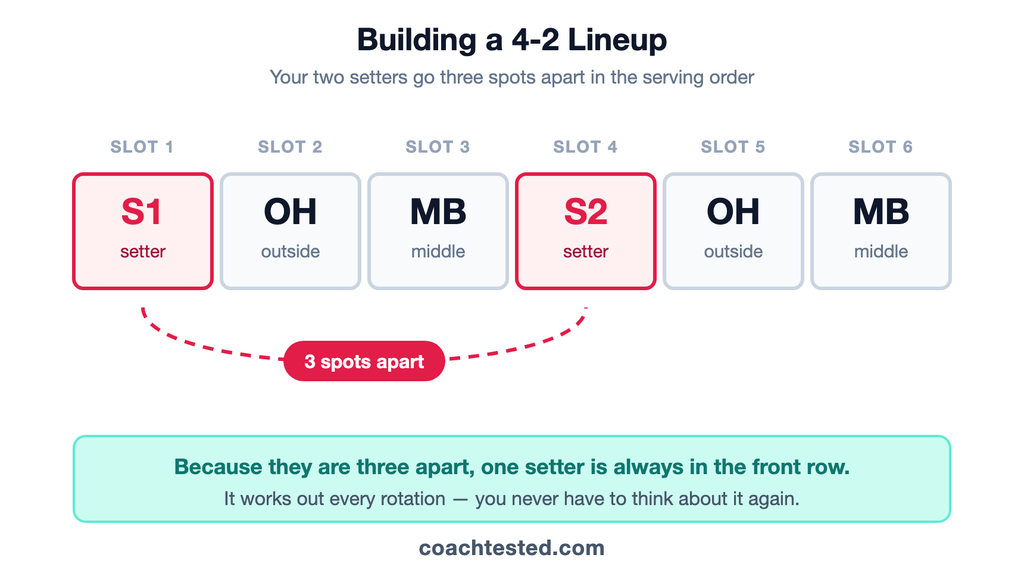
You need two setters, and they go three spots apart on the lineup card.
A standard 4-2 serving order looks like this:
- 1. Setter A
- 2. Outside hitter
- 3. Middle
- 4. Setter B
- 5. Outside hitter
- 6. Middle
Because the setters are three apart, the rotation guarantees that exactly one of them is in the front row at all times. When Setter A rotates to the back row, Setter B has just rotated into the front row. It works out every rotation, so you never have to think about it again.
Note: The 4-2 is most often used as a developmental system, and many teams progress to a 6-2 or a 5-1 once players are ready for a more complex offense. It isn’t only a stepping stone, though. For certain rosters it’s a legitimate competitive choice, and there’s a section on that below.
Your front row in a 4-2 is always one setter and two hitters. That’s the trade you’re making, and we’ll come back to it.
You only have three rotations to learn
This is the part that makes the 4-2 so much less intimidating than it looks.
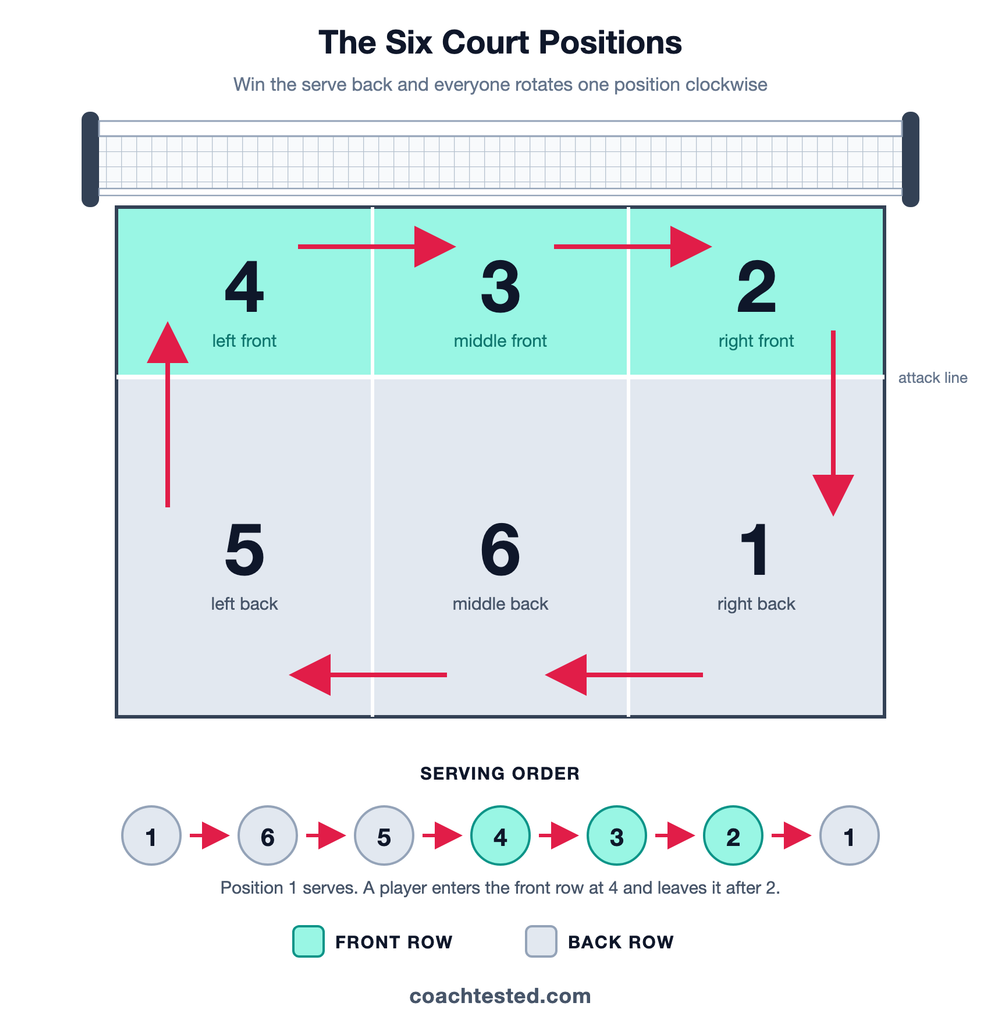
There are six rotations in volleyball. But in a 4-2, your front-row setter is only ever in position 4, position 3, or position 2 — and then the pattern repeats with your other setter.
Rotations one through three: Setter A is at 4, then 3, then 2. Rotations four through six: Setter B is at 4, then 3, then 2. The picture on the court is identical. Only the jersey number changes.
So you aren’t teaching six serve receive formations. You’re teaching three.
Where the setter sets from
There are two versions, and which version you run decides which pins you can attack.
Setting from right front (position 2)
Your setter switches to the right side after the serve. She sets everything to her left, which means your offense runs through the left pin and the middle.
The trade: you have no right-side attacker. That slot belongs to the setter.
What you get in return:
- She’s stationary at the net, which makes her an easier target for your passers to find
- She isn’t being asked to help block a pin and then get back to set, which is a genuinely hard sequence for a young setter
- Your middles can start learning the slide, which becomes a part of their game later
- It encourages back-row attacking as your team develops
- It works better for hands that aren’t great at back-setting yet
Setting from middle front (position 3)
Your setter moves to the middle. Now you can attack both pins, left and right, and you keep the high middle ball that many teams find easiest at this level.
The trade: she has to cover the whole net. She becomes a moving target for passers, she’s harder to find under pressure, and she’s more likely to be caught out of position on a scramble.
Which to run
Run the right-side version if you can. The long-term development argument is strong, and coaches who’ve taught both tend to land there.
Run the middle version if your setter can’t yet deliver a clean ball to the left pin from position 2.
The three rotations, one at a time
Setter in position 4
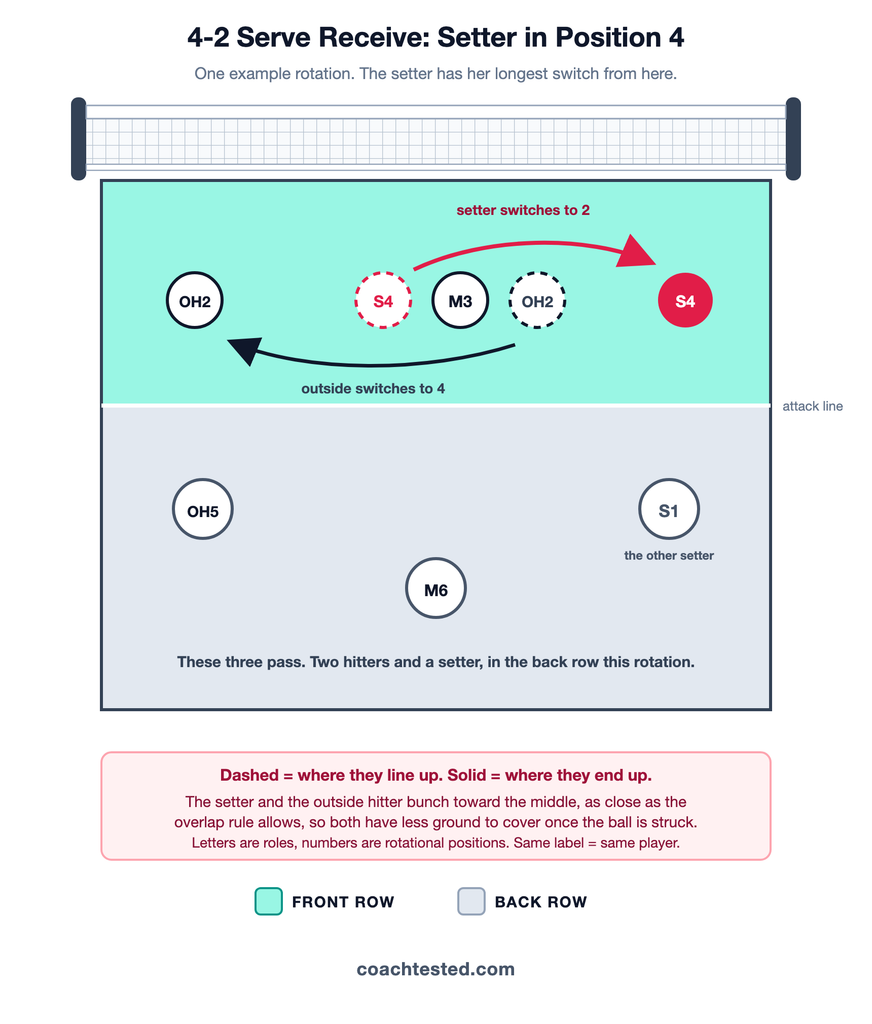
Her longest switch. The setter and the position-2 hitter line up as close to the middle as the overlap rule allows, so neither has far to travel. The instant the serve is contacted, the setter runs right to position 2 and the hitter runs left to her pin.
Setter in position 3
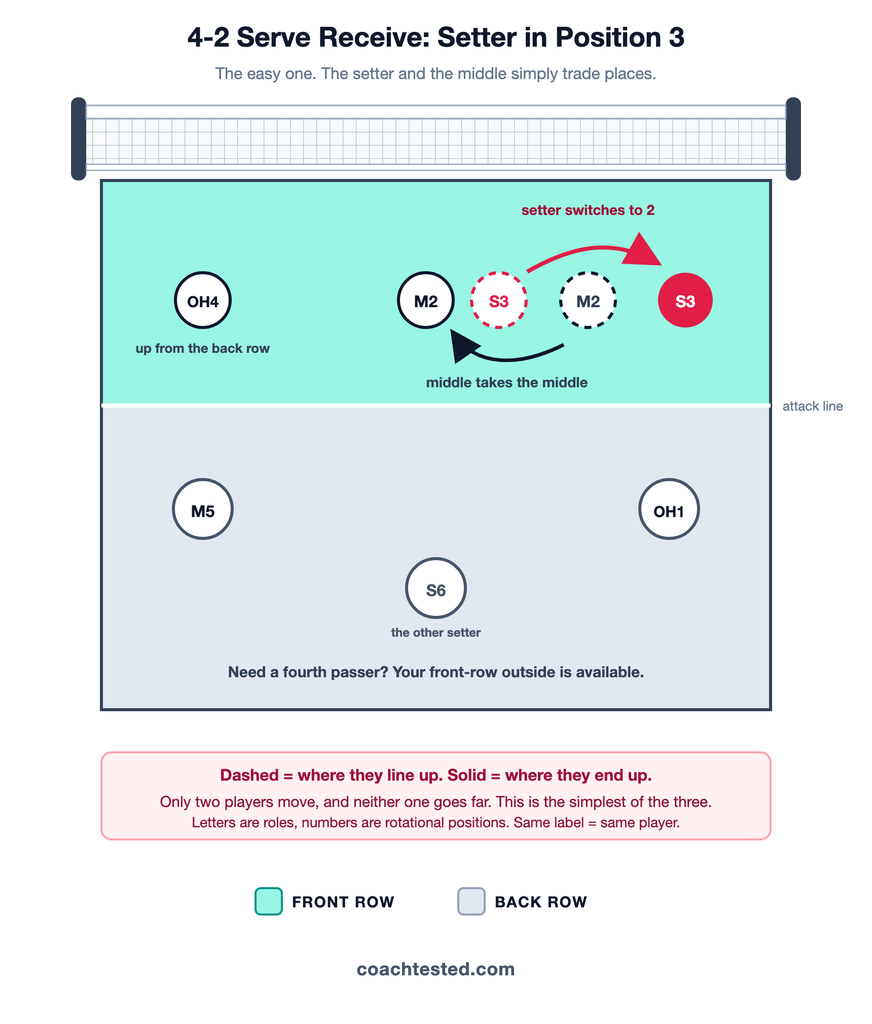
Your shortest switch. The setter slides right to position 2, the middle takes over the middle, and neither one travels more than a few steps.
Your third front-row player is an outside hitter who has only just come up from the back row. She has nowhere she needs to be, so park her off the net on the left and let her get her feet set. If you would rather have her in serve receive, she is available for that instead.
Setter in position 2
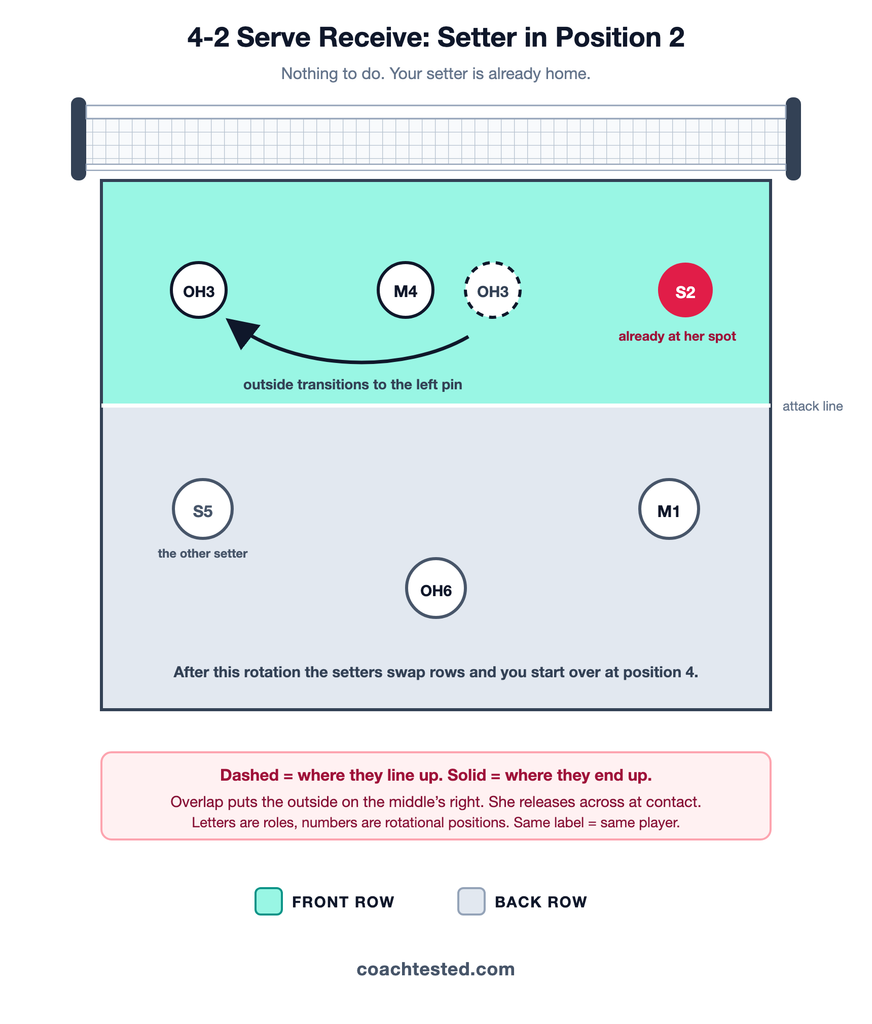
Your setter begins the rally exactly where she wants to finish it, so she does not move at all.
The only adjustment belongs to your outside hitter. The overlap rule puts her on the middle’s right, and she releases across to the left pin the instant the ball is struck.
When this rotation ends your setters trade rows, and the cycle restarts at position 4.
The adjustment that saves a young setter
Set the middle first. The long set to the outside is the hardest ball a new setter has to produce, and most of them struggle with it for months. Give her a rule she can apply in half a second: clean pass and time to turn, she can go outside. Anything else goes middle. Her success rate climbs immediately, and your middle starts getting swings. Once that rhythm clicks, the rest comes faster than you expect. My middle on a regional 12s team last year had never hit a ball before that season. She got set constantly, because the middle was the easy ball for our setter, and by the end of the year she was playing outside. The turn came when she and our setter found each other and she started going after kills instead of just getting the ball over the net.
The simplest version of all
If your team is brand new, you can strip a 4-2 down until almost nothing moves: the setter switches, and nobody else does. Your other two front-row players just decide between themselves who takes outside and who takes middle.
No specialization, no crossing, no memorized switches. You’re running a real rotation on your first day, and you add the rest as they’re ready.
Serve receive: the setter doesn’t pass
Your setter is not a passer. She’s in the front row, so keep her out of the passing lanes. Your three back-row players take serve receive. The setter starts wherever the overlap rule allows, and the instant the serve is contacted, she moves to her setting spot.
Your two front-row hitters step off the net to be ready to approach. They aren’t passing either, unless you have nobody else.
Give her one word for when she can’t take it. If the pass is far enough off that she has no play, she calls “HELP!” and whoever is closest takes the second ball. One syllable, decided in advance, and nobody stands there watching it drop.
The three-passer formation shown in the diagrams above is one of the simplest and most common versions used with a 4-2. Serve-receive shapes vary. Some teams use a full W with five passers, a four-passer U, or specialized three-passer alignments, depending on personnel and skill level.
One quiet advantage: because your setter barely moves, everyone else on the court is available to pass if you need them. Most teams use three. You have the option of more.
Base positions: where everyone goes once the ball is live
Serve receive is where you start when the other team serves. Base is where you go the moment the ball crosses to the other side and the opponent has it. Then you leave base to do your job, and you come back.
In a 4-2, base is simple because so little moves:
- Setter — right side, at or near the net, wherever she sets from
- Middles — middle of the court, front and back
- Outsides — left side, front and back
Your players learn one home instead of six. That’s most of the reason the 4-2 works for a young team.
The cue that makes it stick: when the ball crosses the net, everybody goes to base. Say it the same way every practice until you don’t have to say it.
One defensive note for young teams: don’t push your middle back defender too deep. Most balls at this level land in a fairly small box in the middle of the court, not on the end line. Put your defenders where the ball actually goes.
The overlap rule
At the moment the server contacts the ball, every player has to be in the correct position relative to the players next to them. Front-row players must be in front of their back-row counterpart, and within each row, left has to stay left of middle, middle left of right. Overlap wording differs slightly between codes and gets revised. Check the current rulebook for your level — USA Volleyball for club, NFHS for most school ball.
The instant the serve is contacted, all of that stops mattering. Everyone can move anywhere.
That’s why switching exists. Your setter starts in a legal spot, the serve goes up, and she switches to position 2 or 3. Perfectly legal, as long as she was lined up correctly at contact.
Substitutions in a 4-2
In a 4-2, your substitutions are mostly about playing time, not tactics.
Because the system is symmetrical and the setter is always front row, there aren’t many clever moves available. You’re subbing to get kids on the court.
A few practical notes:
- Use your subs. At the developmental level, court time is the point.
- Consider a libero. A libero replacement isn’t a substitution and doesn’t count against your total, which makes her effectively free. She usually replaces a middle once that middle rotates to the back row. Plenty of younger teams don’t use one at all and let their middles play the full rotation instead.
- A common upgrade: when your front-row setter rotates to the back row, sub her out for a better passer or defender, and bring your other setter in on the opposite side. Two coordinated subs, run every three rotations. That pattern has its own name, the 5-2, and it’s a natural next step from a 4-2 without jumping all the way to a 6-2.
When a 4-2 is the right competitive choice
The 4-2 gets dismissed as a beginner system. For some rosters that’s wrong.
Consider it seriously if:
- You have no reliable right-side attacker but strong middles. The 4-2 with a right-front setter runs your offense through the left pin and the middle, which is exactly the offense that roster already has.
- You have two good setters who connect differently with different hitters. In a 5-1 one of them sits. In a 4-2 both play, and each pairs with the front row she works best with.
- You want three real defenders in the back row every rotation. In a 5-1 or 6-2 the setter in your back row is a defender in name only — she is waiting to release, and once she has released she is standing at the net, too far forward to dig and not there to block. You are defending with five. A 4-2 never has that problem.
- You’re short on numbers. A 4-2 runs cleanly with a small, stable group.
Coaches have won plenty of matches with a 4-2 at levels where they were “supposed to” have moved on. The system isn’t the ceiling. The roster is.
What the 4-2 gives you
- Predictability. The setter is in the same place every rotation. Players stop asking where to go.
- Fewer moving parts. The only switching happens in the front row. That means fewer overlap faults, fewer whistles you can’t explain, and players who stop running laterally into each other.
- A coachable system. You can see what went wrong and fix it between points.
- Development for everyone. With two setters, more athletes learn to set. The ones who never set still learn what a setter needs from them.
- Three real defenders in the back row, always.
- Only three rotations to learn.
What the 4-2 costs you
- You attack with two hitters instead of three. Your setter occupies a front-row slot. A good opposing coach figures that out fast and blocks accordingly. At higher levels teams solve this with back-row attacks; a young team usually can’t, which is why this bites hardest at exactly the level that runs a 4-2.
- You lose a pin. Depending on where your setter sets from, either your right side or your setter’s range is gone. There’s no version where you get both.
- Your offense is readable. Fewer options, and against a team that’s paying attention, it shows up by the second set.
- Your setter has to block. She’s front row every rotation. If she’s your shortest player, that’s a hole opponents will find.
- Two setters means splitting reps. Neither one gets as many touches as a single setter would.
- It disappears above a certain level. Your players will not see a 4-2 again once they’re playing competitive high school or club ball. Whatever it teaches has to be transferable, because the system itself won’t come with them.
The 4-2 trades offensive ceiling for execution. For a team that can’t yet pass a ball to a target, offensive ceiling is not the constraint. Contact is.
How to teach it
Ghost drills. No ball. Line your team up and walk them through every rotation three ways: where they stand when you serve, where they stand in serve receive, and where they go on defense. Run it at the start of every practice until nobody has to think.
Paper plates. Write each player’s number on a small paper plate. Lay them out in the starting rotation on a table and walk them through all six rotations — which is only three serve receive pictures, twice. Do it yourself first, until it’s automatic, then let the players move the plates. They’ll see who ends up next to whom, which is the thing that’s hardest to explain in words.
Give them a rotation sheet to take home. One page, their spot in each of the three pictures. A player who has looked at it overnight arrives at practice already halfway there.
Teach base positions, not rotations. Players don’t need to memorize six diagrams. They need to know where they start and where home is once the ball is live.
How long it takes: you can walk a team through all three rotations in about twenty minutes. Getting it to hold up under a real serve, in a real match, takes a few weeks.
Before you leave: grow the offense inside the 4-2
You don’t have to change systems to add something new. A 4-2 has room in it.
Add a middle slide. Once your setter can back-set, your middle can slide behind her and attack from the right side. Now the defense has two places to look instead of one, which matters most when you can see them cheating toward your left pin.
Add the setter dump. Your setter is at the net every rotation with her hands on the second ball. A tip over a committed blocker is free, and young teams almost never defend it.
When to move on
You’re ready to leave the 4-2 when:
- Your passers can consistently deliver a ball a setter can set
- You have a setter who is also one of your better attackers
- You have more than two hitters worth setting
- Overlap has stopped being a problem your team creates
The natural next step is a 6-2, where your setters come out of the back row and you get three front-row attackers, or a 5-1, where you only run 1 setter the whole way around.
There’s a useful way to think about the whole ladder: a 5-1 is really two systems taking turns. The three rotations with your setter up front look like a 4-2. The three with her behind the attack line look like a 6-2. Nothing you install at the bottom of the ladder gets thrown away.
Not everyone believes in climbing it one rung at a time. Some coaches argue you should teach the system you intend to finish with and skip the re-teaching entirely. That’s a defensible position, and it depends on how much practice time you have and how much of it you’re willing to spend on installation.
If that’s the argument you’re weighing, I’ve worked through it in detail: Should Middle School Teams Run a 5-1? It comes down to four questions, and grade level isn’t one of them.
One final note about using a new offensive system after the 4-2: use it in an “easy” game first, not a high-pressure one. Give them a chance to practice it in a real but low stakes game.
Common mistakes
Putting your setters next to each other in the rotation. They have to be three apart. If they’re adjacent, you’ll have rotations with two setters in the front row and none in the back.
Letting the setter pass. She’s front row. Keep her out of it.
Teaching six rotations instead of three. Your front-row setter is only ever at 4, 3, or 2. Teach those three pictures and the rest is repetition.
Only teaching two players to set. Teach everyone the basics. Setters get hurt, get sick, and move away, and the coach who has your players next year will be grateful.
Changing the system after one bad match. One bad night is not evidence. Wait until the same thing has gone wrong across several matches, then change one thing.
Chasing the system your neighbor runs. The right rotation is the one that fits the athletes in your gym, not the one the A team uses.
Common questions
Why is it called a 4-2? The name counts the roles: four players hitting, two setting. It’s approximate once you add a libero, but the split is where the name comes from.
How many rotations do I actually have to teach? Three. Your front-row setter is only ever in position 4, 3, or 2, and then the pattern repeats with your other setter.
Can you use a libero in a 4-2? Yes, and plenty of teams do. The usual arrangement is to bring her on for whichever middle has rotated behind the attack line. Younger teams often skip the libero entirely and let their middles play all six rotations, which is also fine. If you don’t have one, the no-libero translation applies here too — read every diagram’s “L” as your back-row middle.
Which setter sets when both are on the court? Always the one in the front row. The back-row setter is a defender and a passer like anyone else until she rotates up.
Do high school and college teams run a 4-2? Rarely. Above the developmental level almost everyone runs a 6-2 or a 5-1, which is why the 4-2 is best understood as a foundation rather than a destination.