My Daughter’s New Coach Changed Her Technique and Her Confidence Is Gone
Confidence doesn’t come first, it comes last. So when a new coach changes how your daughter plays and one bad tournament or game takes her apart, confidence isn’t the thing to work on. It comes back on its own once she can do what she’s being asked to do, and there is no way to hurry it.
Table of Contents
Jump to a section
I get some version of this question from parents on occasion.
My daughter is a decent setter. Not exceptional, but solid. A year of club, a couple of years of school ball. She made JV this year and the coach doesn’t know anything about her history. The coach wants her to set a different way, and at the first tournament she was a mess. She made mistakes and she stopped trusting herself. How do I help her get her confidence back, and how does she show this coach she’s working on it?
I have watched this from both sides — as a coach and as a parent. My own daughter went through a similar situation her first year of club. She joined a team that was playing at a higher level than she was, faster-paced, more competitive, and her coach wanted her to get up to speed. It was a whole season of emotional ups and downs watching from the sidelines, getting my hopes up during her good times only to have them come crashing down during her bad times.
As a coach, I have asked a lot of players to change something, knowing it would help them and help the team. The difference is that I am looking at the top of the mountain and the player is looking at the climb.
I know the slog is coming. I also know what is waiting at the top and that it is worth the trip. But I am asking her to take that on faith and keep walking while all she can see is the hill.
This is a lot easier to hand out as a coach than it is to accept as a player or a parent! It’s tough to watch your own kid go from confident to shaky.
So, to the parent who asked: nothing is wrong with your daughter and you don’t need to rescue her.
She was asked to change a habit she’s built over three seasons, then asked to perform it in a tournament, on a new team, in front of everybody. Any athlete in that position is going to struggle.
Several problems converged. While your daughter was learning to change, other players on the team were too, and nobody was performing at a high level. The passes weren’t perfect, nobody’s mechanics were automatic, and none of them had enough reps to have learned each other yet.
You can’t change habits overnight
A technical change lives in slow reps. You can hold a new pattern in a drill, at a controlled tempo, thinking about it. Put a real serve, a scrambled pass, and a scoreboard on top of it and almost every athlete reverts to the pattern she’s done ten thousand times.
That isn’t a character flaw, it’s how skill acquisition works. A movement has to pass through stages before it runs on its own, and until it gets there, an athlete who stops consciously thinking about it reverts to the version she already owns.
So a first tournament or game is the worst possible place to measure a change that started recently. The change hasn’t failed. It hasn’t been installed yet.
Anything you install in a gym takes weeks, sometimes months, of repetition before it survives real competition.
“Wrong” and “different” are not the same thing
Sometimes a coach wants a player to change to match the coach’s system, not necessarily to correct them. A new hitting coach rebuilding a swing mid-season is the same problem in different equipment.
But an athlete who has had two previous coaches may experience system preference as criticism. She hears “you’re doing it wrong” when it’s really “we do it this way here.”
An athlete losing confidence needs courage
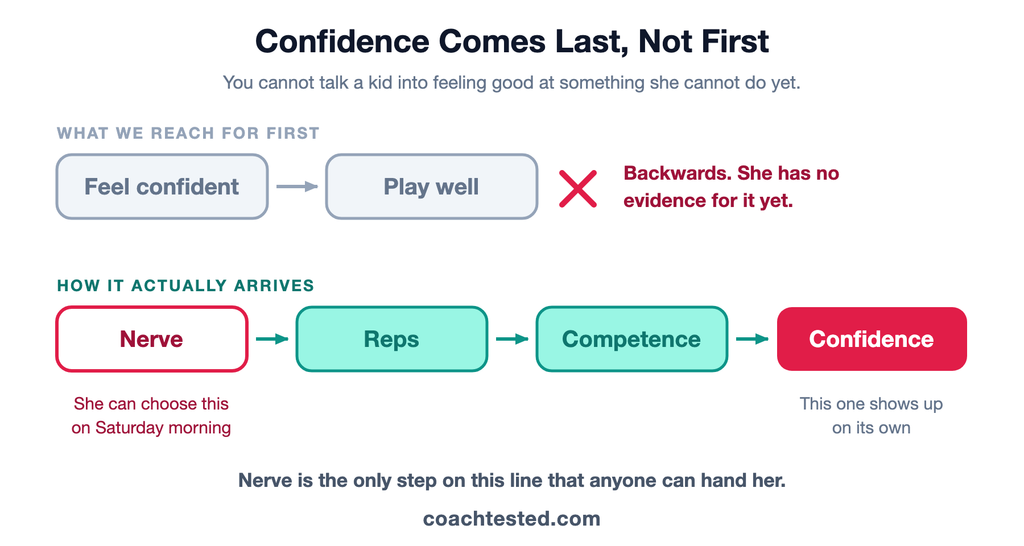
You can’t give a kid confidence in something she can’t do yet. Confidence isn’t the fuel, it’s the receipt. It arrives after she’s watched herself do the thing correctly enough times to expect it, and there is no shortcut that skips the reps.
Which means the reassurance in the car — you’re great, you’ve got this, don’t worry about it — doesn’t land. She just spent four hours collecting evidence to the contrary. Telling her otherwise mostly teaches her that your read on her game isn’t reliable.
What’s actually available to her right now isn’t confidence. It’s nerve.
Nerve is walking back out and taking the second ball again, the new way, knowing it might go badly again. It’s saying out loud, “I’m not good at this yet, I know what my coach asked for, and I’m going to keep trying it in a game.” That’s a much smaller ask than feeling good about it, and unlike confidence, she can choose it.
Confidence shows up later, on its own.
How she shows the coach she’s working on it
This was the second half of the question. All of it is hers to do, not yours.
Ask for one thing, not a list. Coaches often hand out three corrections at once. She should ask which one matters most right now, and work only on that. A setter trying to fix her hands, her footwork, and her tempo in the same week fixes none of them.
Ask a specific question, not a general one. “How am I doing?” gets a shrug. “You want my hands higher — is that on every ball, or just off a good pass?” tells a coach she’s been thinking about it since Saturday.
Get reps outside of practice. Wall sets are free. This is also the one place you as a parent can genuinely help: be the person who tosses balls, not the person who evaluates them.
Film it. As a coach I whip out my phone all the time and take video of my players doing the things I want them to change. Seeing it is more helpful than just telling them. Often they cannot grasp what they are actually doing that needs to change until they see it.
Don’t complain or do it begrudgingly. Players get a lot of grace when they try hard to do something hard with a good attitude.
Don’t send the coach her résumé
Your instinct is going to be to make sure the coach knows she played club, that she started for two years, that she’s better than what they saw. Don’t do it! As much as you want to solve this problem, your best bet is to stay out of it.
Coaches read that as pressure, and it converts your daughter from a player into a parent’s project. It also doesn’t work: what she did in a different gym isn’t evidence to this coach. Reps in this gym are, and there will be plenty within a few weeks.
How long before it looks better
Weeks, not days.
Changing an athlete’s technique, with consistent reps, is a three-to-four-week project before it holds up during competition. Team chemistry — knowing her hitters’ tempo and height — takes about the same. Both clocks are running at once.
Judge it in a month.
When it’s actually a problem
Most of the time this is a normal, unpleasant, temporary setback. Sometimes it isn’t, though.
Pay attention if she’s getting outcomes instead of instruction — “that was terrible” with nothing attached to it, week after week. Or if she’s being blamed constantly for bad sets that were bad passes first. Or if she’s stopped wanting to go to practice at all, which is different from dreading a hard practice.
Any of those is worth a calm, curious conversation with the coach, asking what they’re working on with her rather than defending her. Also, sometimes, and this is unfortunate, a coach just doesn’t wind up being a great fit for your kid for whatever reason. Even this is something that can be learned from — not everyone in life is going to like you or recognize your potential or even be fair, and that isn’t a verdict on you and doesn’t need to derail you either.
Culture flows downhill. How a team behaves is a reflection of its coach, and if what’s happening to your daughter turns out to be about the culture rather than her technique, no amount of wall sets is going to fix it. That’s when it’s worth looking for another team.
The short version
She doesn’t need to feel confident. She doesn’t need affirmations or mantras or fake praise. What she needs is action. Her action. She needs to keep taking the second ball while she’s still bad at the new version, and she needs one specific thing to work on instead of five.
Your job as a parent is smaller than it feels. Feed her balls when she asks, don’t coach in the car, and don’t tell her she was great when she knows she wasn’t.
Tell her to expect it to be hard and to keep going anyway. Don’t promise her it will all pay off, because you don’t know that. What you can tell her is that the work is worth doing either way.
Character development is just as much the point here, and in my experience it has always arrived against my will and been appreciated much later.

One Comment
Comments are closed.