Where to Hide Your Weakest Fielder: Youth Softball Positioning Guide
You have nine positions, twelve names on the roster, and two or three kids who still appear to be shocked when the ball rolls toward them. You see defensive diagrams that assume nine competent fielders.
That is not the field you are standing on.
Plenty of 10U and 12U coaches ask the question: where do I put my weakest fielder in youth softball so she is safe, the inning does not unravel, and she still has a chance to get better?
Hiding a beginner can settle the next five minutes and cause trouble for the rest of the season. She can be unready for some jobs and still have a real job today, plus a clear route to the next one.
Jump to a section
The two things that actually matter
Forget the traditional position pecking order for a minute. When I’m figuring out where a beginner can survive an inning, I use two things: action and damage.
Action: How often is the ball likely to come to this player?
Damage: If she misses it, how much trouble does that create?
A low-action, low-damage spot is a reasonable place to start. Constant action is trouble. So is any position where one missed catch turns a routine out into two extra bases.
At 10U and 12U, most batted balls stay in the infield. Most youth hitters are right-handed too, which generally sends more pulled balls to the left side. Your pitcher, catcher, first baseman and shortstop touch too many important plays. Those spots will expose a beginner in a hurry.
The green positions below still take work. They are simply the least bad place to start while you teach.
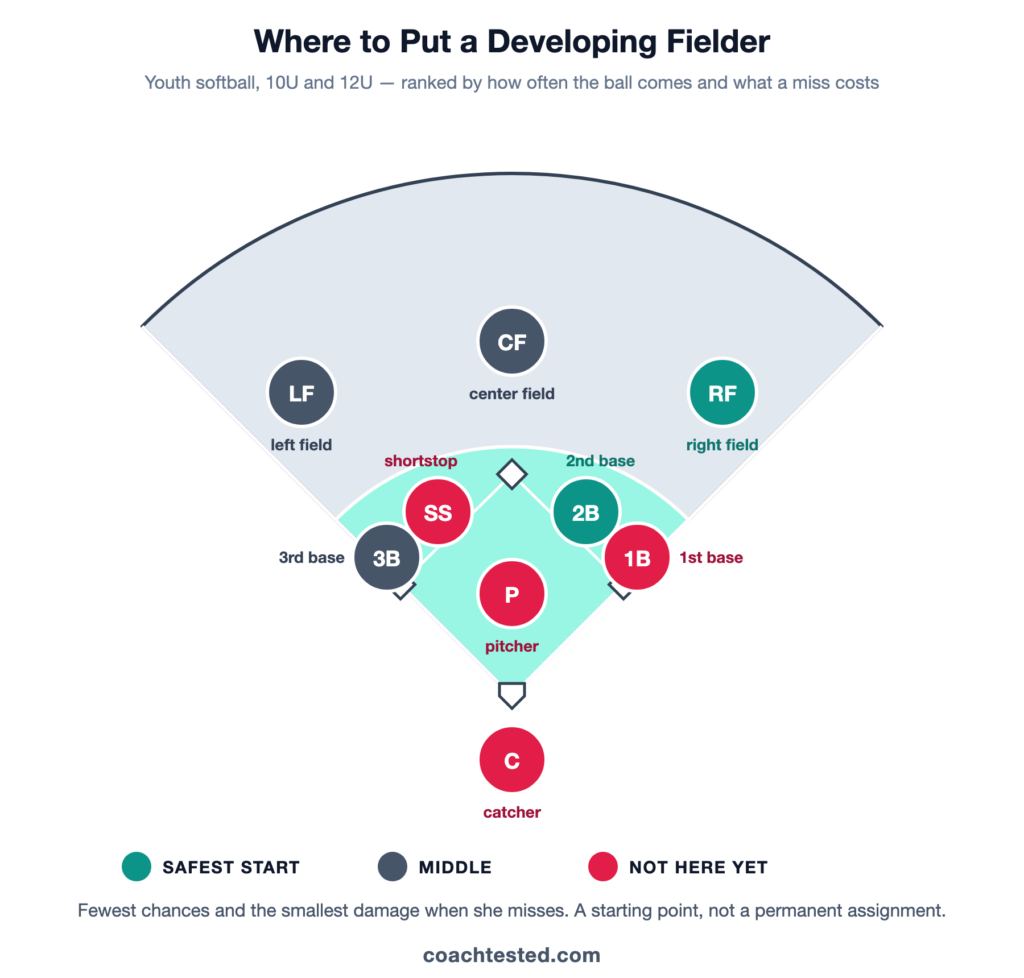
Teal = fewest chances and the smallest damage when she misses. A starting point, not a permanent assignment.
The honest debate
Ask ten coaches where to place the least-developed defender and you will get at least three answers.
School 1: Right field gets the fewest balls
This is the conventional answer. Against a lineup full of right-handed hitters who pull the ball, right field often sees fewer batted balls. A true beginner can settle in, work on a ready position and make the occasional play without taking a grounder every other batter.
There is a catch. Right field is not a lawn chair. She has to back up first base on throws from the left side, move on contact and get the ball back to the infield. Left-handed hitters, or girls who consistently hit the other way, can change that traffic pattern fast.
School 2: Right field is really deep infield
Some experienced youth coaches argue the opposite. At this age, a sharp ball into shallow right can turn into an out at first, and every wild throw over there needs a right fielder sprinting behind the bag. Those coaches want a dependable, alert player in right. The weaker defender goes to left.
That works when your pitcher keeps right-handed hitters late or the other team rarely pulls the ball. Against a lineup that lives on the left side, it can get ugly. The left fielder usually has a shorter throw to third, but she may spend the day getting tested.
School 3: Center field keeps the job simple
A third group puts the least athletic player in center. The throw back to second is short and straight, the first backup job is easy to understand, and strong corner outfielders may close some of the gaps. That is the theory, anyway.
I understand the logic. Center field still covers too much space for this to be my first choice. If the player freezes on contact or cannot track a rolling ball, the middle of the outfield becomes a runway.
My recommendation: For a true beginner, I start with right field or second base. Right usually offers fewer chances. Second gives her the shortest routine infield throw and, most days, less traffic than shortstop. A kid who cannot yet catch a routine ground ball starts in right. Once she can field one and make a short, accurate throw, second becomes a legitimate developmental spot. She still has to keep her brain switched on.
Weakest fielder placement, position-by-position
Pitcher. Fields a lot of close range balls. The pitcher also covers bunts, backs up throws and has to recover after every pitch. Not a good spot for a girl with a weak glove.
Catcher. She is involved in every single pitch. She needs proper gear, some toughness and a coach willing to teach receiving, blocking and where to go after the ball. Choosing the kid who happens to fit the shin guards is how a long inning gets longer.
First base. I want my best catcher here. Height is useful, but it does not secure the throw. A terrific shortstop cannot help much if first base misses it, and nearly every routine infield grounder is trying to end at this bag.
Second base. This is the friendliest infield starting point. The throw to first is short, and the traffic is usually lighter than it is at shortstop. She still needs ground-ball work. She also has to cover first on some bunts and know who owns second.
Shortstop. Against mostly right-handed hitters, this is often your busiest infielder. She needs range, a reliable glove and enough arm to finish the long throw. Game day is a lousy time to discover that a beginner cannot handle it yet.
Third base. She may get fewer routine chances than shortstop, but the balls get there hard and the bunt responsibilities get there fast. I use an engaged, reasonably fearless player and give her enough depth to stay safe for the hitter in front of her.
Outfield. Give every outfielder a job on every pitch or she will check out. Right field backs up first on thrown balls. Center backs up second and helps both gaps. Close games get won and lost out there, even at 10U, so do not hand outfield to a kid like it is punishment.
Hiding is a starting point, not a sentence
In rec ball, I would rather spend one rough inning while a player learns second base than win it by keeping her in right field for three straight months. The scoreboard disappears. Her belief that she is “the bad one” can hang around a whole lot longer.
Kids notice the depth chart. Adults can pretend otherwise; the kids still know. If a player is losing confidence after a coaching change, give her one meaningful responsibility and one visible step forward. That will do more than another speech about confidence.
Move players around in rec games. Every kid gets infield reps in practice, even when some are not game-ready yet. One can start an inning in right, move to second later and finish the week working on first-base receiving. Your defense does not have to become a science experiment.
Standard USA Softball and National Federation of State High School Associations (NFHS) substitution rules generally allow a player to re-enter once in the same batting-order position. Many rec leagues go further with continuous batting orders, minimum-play rules, or unlimited defensive movement. Check your local league rules before you plan mid-game moves; local rules control, and a defensive switch is not always treated the same as a lineup substitution.
Use whatever legal flexibility you have. An opening lineup should not become a permanent label.
A kid parked in right field all season learns how to stand in right field. She misses the footwork for a ground ball, the rhythm of a throw to first and the chance to recover after an error. By 14U, the ball finds everybody. An unprepared player may decide softball just is not for her.
What this means for practice
Practice needs to match where outs actually come from in 10U and 12U games. The best fielders cannot get fifty useful reps while the beginners shag fly balls at the fence. That is batting practice with witnesses.
Make first base a receiving station. Throw from shortstop, second and third. Mix in good throws, low ones and a catchable one-hop ball. Teach the first baseman to find the bag, show a target and secure the ball before she tries anything fancy.
Feed routine grounders to pitcher, shortstop and second. We are after a glove on the ground, feet underneath the body and one calm throw to the correct base.
Give outfielders movement jobs. The off-ball outfielders move on every rep. They back up a base or a teammate. A ball hit to shortstop should still send the right fielder sprinting behind first.
Get the ball to the cutoff. Young outfielders love launching the ball toward home because it feels important. Usually it just rolls around while runners keep moving. A firm throw to the cutoff can hold the next runner and gives the defense a chance to reset.
Create a promotion path. Tell the beginner exactly what earns the next opportunity. It might be five clean grounders. Maybe it is three accurate throws to first, or correct backup movement on every rep.
Keep the reps short enough that players stay sharp, too. Ten focused balls with a clear job beat thirty bored ones hit into a crowd.
Bottom line
For most 10U/12U rec teams, I start a player who cannot reliably catch yet in right field. Once she can handle a routine grounder and a short throw, second base is the better developmental step. Give her one real responsibility. Move her when the rules allow, then build the next skill in practice. Hide the weakness for an inning if you need to. Do not hide the player for a season.
