How to Run a 5-1 Rotation: Two Bases and One Trigger
In a 5-1, one setter sets every ball, in all six rotations. Three of them from the front row, three from the back. Five players hit, one player sets, and the setter never comes off the court.
The concept isn’t what confuses people. The movement is. Your setter has to be in a different place before the serve than she is after it, in every rotation, and getting that right is most of the work.
Who this is for: coaches installing a 5-1 for the first time, and coaches who have one running but keep getting whistled for overlap or keep finding their setter out of position. If you’re still deciding whether to run one, start with Should Middle School Teams Run a 5-1 rotation? instead.
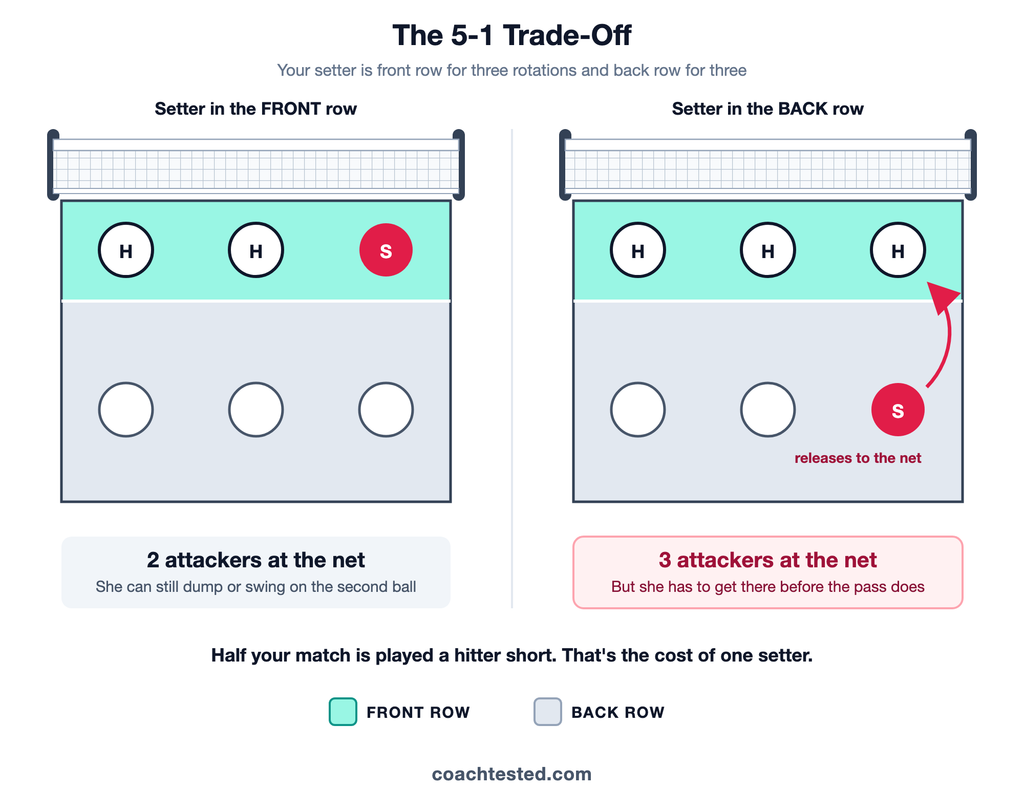
Table of Contents
Where the name comes from
Five hitters, one setter. The numbers count roles on the court, not bodies on your roster.
That’s worth saying because the names trip people up. Count the court, not the bench: the second number tells you how many setting slots are in the rotation. A 5-1 has one, and one player fills it for all six rotations. A 6-2 has two. A 4-2 has two as well, but both of them set from the front row.
So a 5-1 isn’t “the system with one setter on the team.” You should have two or three players who can set. It’s the system where one of them sets every ball.
Building the lineup
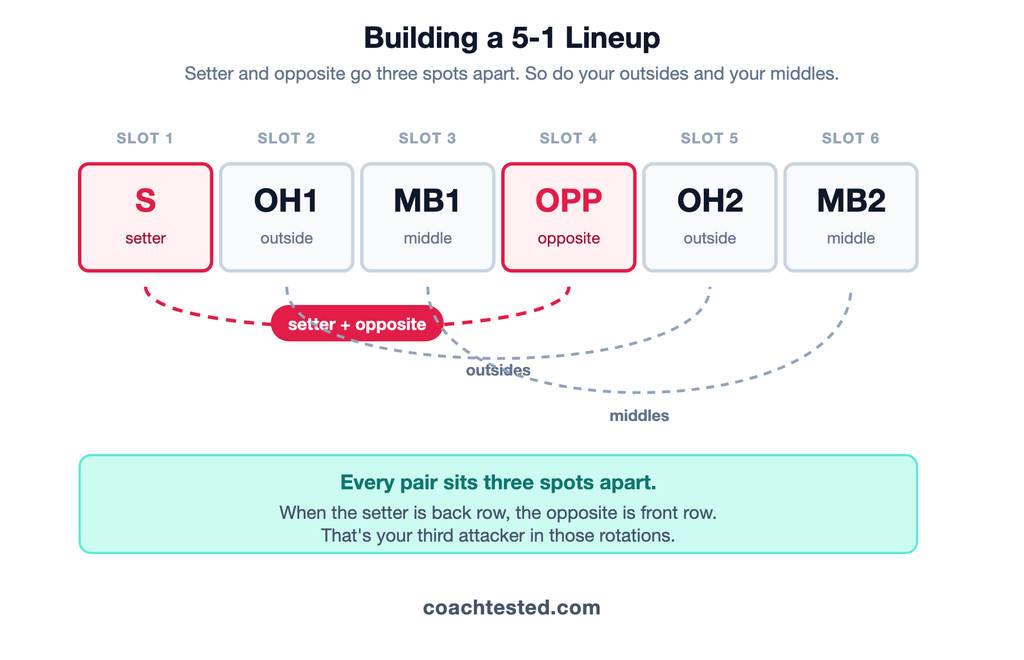
Your setter and your opposite go three spots apart in the serving order. That’s the only structural rule.
A standard 5-1 lineup:
- 1. Setter
- 2. Outside hitter 1
- 3. Middle 1
- 4. Opposite (right side)
- 5. Outside hitter 2
- 6. Middle 2
Because the setter and opposite are three apart, whenever your setter is in the back row your opposite is in the front row. That’s exactly what you want, because the opposite is your third attacker in those rotations.
Your outsides are also three apart, and so are your middles. That isn’t a coincidence. It’s what keeps one of each in the front row at all times.
One practical note about filling in the card: this is the pairing to protect. If you break the setter–opposite spacing to solve some other problem, you’ll get rotations with no right-side attacker and rotations with two.
There’s a checking trick worth knowing once you’ve written the card. Lay it out the way it’s written above and you’ll see that your setter and your opposite each follow a middle in the serving order. That falls out of the three-apart spacing rather than being a rule of its own, but it’s a fast way to spot a card you’ve filled in wrong, and it gives your setter something concrete to track: she knows which teammate serves ahead of her.
And once you see the shape of the card, the whole system gets easier to hold. Read the serving order as two groups of three:
Setter — outside — middle. Then opposite — outside — middle.
It’s the same three-player pattern twice, with the setter swapped for the opposite the second time through. That’s not a coincidence or a convention somebody chose. It is the 5-1: the setter and the opposite are taking turns in one slot, and the outside-middle pair repeats behind each of them. A player who sees that stops trying to memorize six positions and starts seeing three that happen twice.
The two terms that make it click
Six diagrams is the wrong way to teach this. Your setter needs two labels and one trigger.
Call the right-front corner, up at the net, her front-row base. Call right back, position 1, her back-row base. Those are the only two places she ever waits.
The trigger is the serve — not the pass. She waits in whichever base matches the row she’s in, and the instant the server contacts the ball she leaves for the setting spot. She does not wait for her own passer to touch it. A setter who waits for the pass is late to every ball she sets, because she needs to be standing at the spot when the pass arrives, not running toward it.
Once a rally is going, no positional rule applies at all, so the same idea runs on a read instead: she holds her defensive base while the other team is attacking, and leaves the moment she can see the ball coming back to your side.
So she never has to recall rotation four. She answers one question, front row or back row, and the answer tells her where to stand.
The version of this that coaches ask about most often is the handoff between the two: does her base change when she rotates out of the back row into the front row? Yes. In the back row she waits at position 1. The moment she rotates up, her base becomes the right front, at the net — and it has to, because that’s what leaves the middle and the left pin open for your other two front-row players to hit from. If she keeps waiting at position 1 while she’s front row, you’ve got a hitter standing in the back of the court and an empty spot at the net.
The rest of the team can run on the same idea. Everyone has a base. You leave it to do a job and you come back to it when the ball crosses the net.
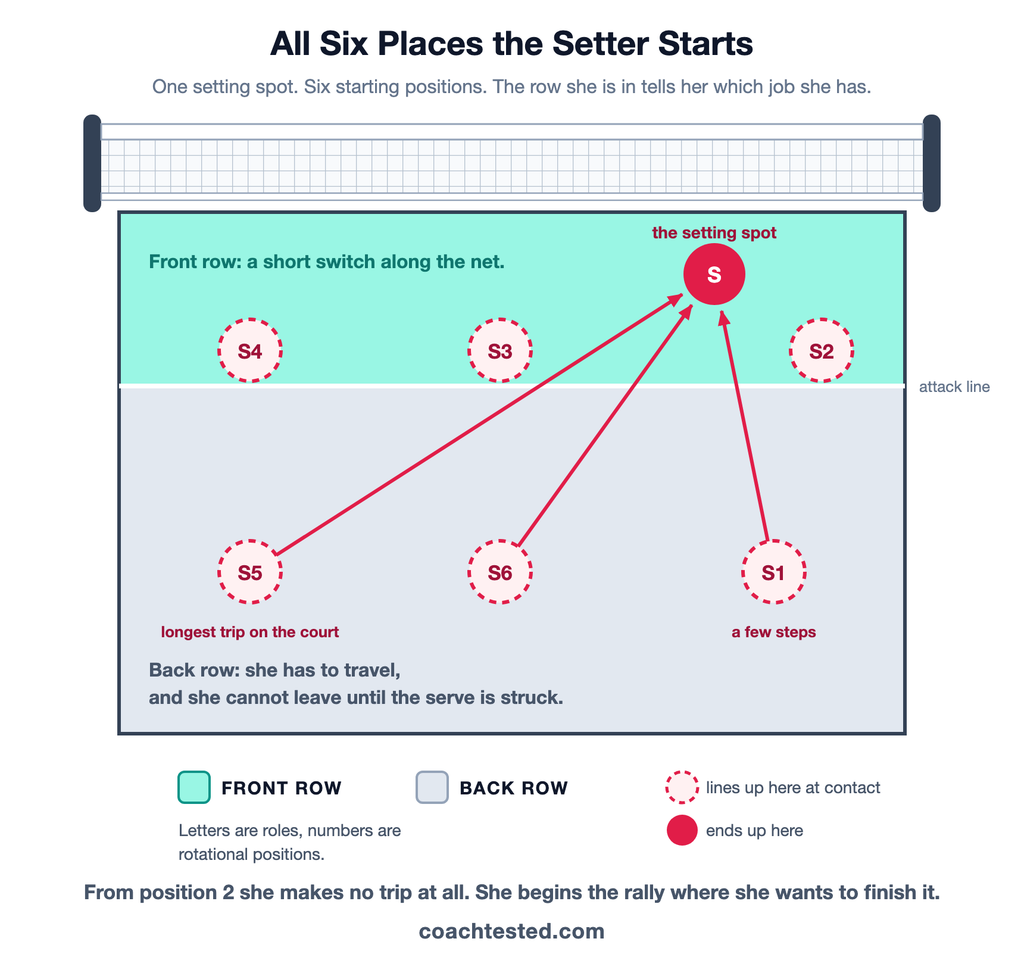
Where the setting spot is
The setting spot is just inside the right front, a step or two off the net. Close enough to set the left pin, far enough that a tight pass doesn’t jam her.
When she’s front row, she’s basically already there. Small adjustment, no sprint.
When she’s back row, she has to travel. From position 1 it’s a few steps. From position 5 or 6 it’s most of the court, and those are the rotations where a late setter shows up as a bad set.
Coach the release, not the destination. And be precise about the rule, because this is where coaches teach it slightly wrong: the fault isn’t moving early. The fault is being in the wrong place at the moment the server contacts the ball. She has to be legal at contact. One instant later she can go anywhere on the court. So the cue is contact, then go — not go when you think it’s coming.
When she’s allowed to leave early
That rule is strict on serve receive and almost everyone teaches it too broadly. Once the serve has been contacted, there is no positional fault left to commit. Players can stand anywhere. So mid-rally, the trigger stops being a rule and becomes a judgment call, and there’s one case where leaving early is simply correct.
On a free ball — the other team shanking it over on two, or sending a high ball with nobody attacking — your setter doesn’t wait for your side to touch it. She reads it and goes. Most teams put a call on it: somebody yells “free,” and that call does two jobs at once. It releases the setter, and it tells the rest of the back row to adjust.
The second job is the one that gets skipped. When your setter leaves position 1, position 1 is empty. If nobody has been told to fill it, she is choosing between doing her job and abandoning a third of the back court.
So assign it out loud, using the names of the actual players. The two remaining back-row defenders widen to split the court behind her, with the libero usually taking the bigger share. It takes thirty seconds in practice and it is the difference between a setter who looks fast and one who looks late.
The rest of the time — a hard-driven ball, a real attack, anything she can’t read early — she is a defender at position 1 like everyone else. A setter who ducks a dig to protect her second touch costs you more than she saves. There is no second contact to make if the first one hits the floor.
The six rotations, one at a time
Coaches name these by where the setter is standing. “Setter in 1” means she’s back right and about to serve. From there she works backward through the rotation: 1, then 6, then 5, then 4, 3, 2, and around again.
Here’s the whole system on one screen.
| Rotation | Setter starts | Row | How far she travels | Front-row attackers |
|---|---|---|---|---|
| Setter in 1 | Back right | Back | A few steps up the right sideline | 3 — outside, middle, opposite |
| Setter in 6 | Back middle | Back | Diagonally, about half the court | 3 |
| Setter in 5 | Back left | Back | The longest trip she makes | 3 |
| Setter in 4 | Front left | Front | Across the net to the right side | 2 — middle and outside |
| Setter in 3 | Front middle | Front | A slide to her right | 2 |
| Setter in 2 | Front right | Front | None. She’s already there. | 2 |
Read the last column and you have the whole strategic shape of a 5-1: for half the match you attack with three hitters, and for the other half you attack with two. Your setter’s three front-row rotations are the ones a good opposing coach is waiting for.
Read the fourth column and you have the whole coaching problem. Setter in 5 is the rotation that breaks young teams. She is as far from the setting spot as the court allows, and she cannot leave until the ball is struck.
Three things follow from the table, and they’re the only three you need to teach:
Her back-row rotations are about speed. Nothing tactical. She has to get there.
Her front-row rotations are about the switch. In two of them she starts somewhere other than right front and has to trade places with a teammate after the serve.
Setter in 2 is free. She begins the rally where she wants to finish it. If your team is brand new, start your install here and add the harder rotations behind it.
Which rotation you start the set in is a choice, not a rule
The order is fixed — 1, 6, 5, 4, 3, 2, and around. Where you enter it is up to you, and it changes nothing about the system.
The conventional choice is to start your setter in 1, serving. From there she’s back row for the opening three rotations, so you play your three-attacker rotations while the set is still close, and a serving run happens with a full front row. Start her in 4 and you open with your two-attacker rotations instead. Across a set it evens out — you’re choosing the order, and front-loading your strongest configuration is a sensible default.
One caution when you compare rotation charts: notation isn’t standard. This article numbers rotations by where the setter is standing. Other sources number by serve order or their own scheme, so somebody’s “rotation 2” may be our “rotation 6.” Check what each chart is counting before you assume the systems differ.
Serve receive: hide the setter
Your setter is not a passer. She’s got somewhere to be.
That means in serve receive, and the distinction is worth saying out loud because players get it wrong: passing is serve receive, digging is defense. You hide her from the first one. You never hide her from the second — when she’s back row and the other team is attacking, she defends position 1 like anybody else, and a setter who ducks a dig to protect her second touch loses the rally she was trying to set up.
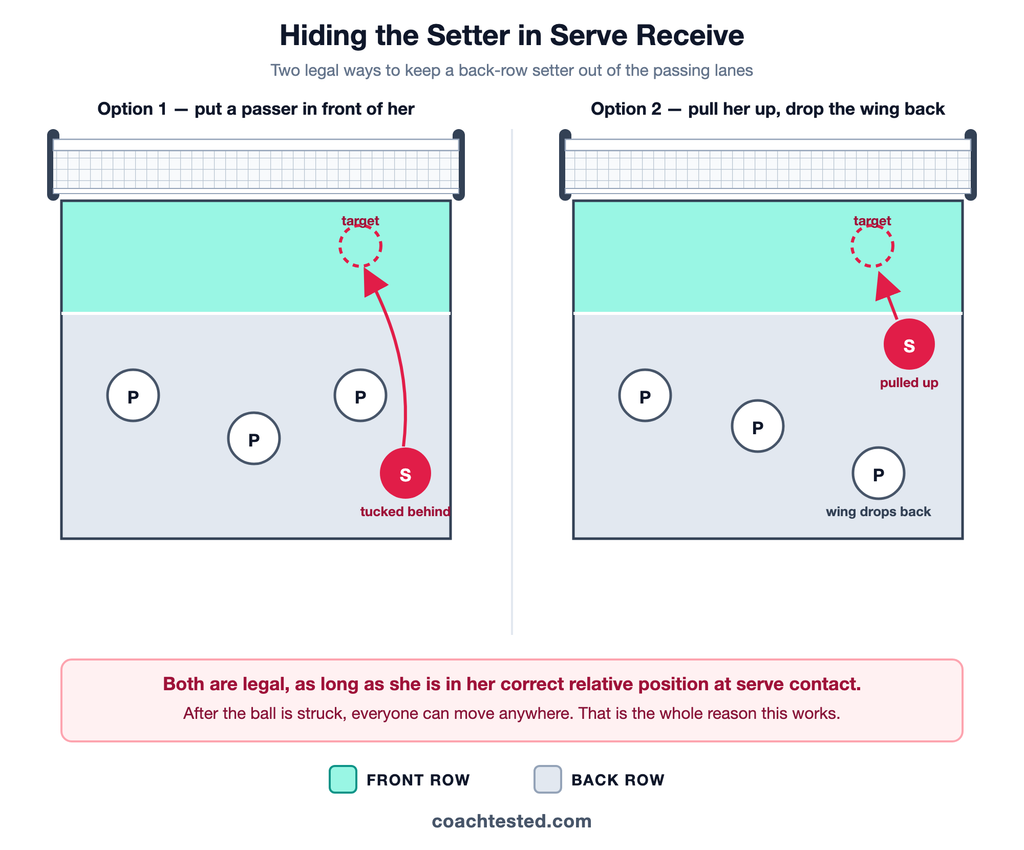
That means in every rotation you’re arranging serve receive to keep her out of the passing lanes, and there are two clean ways to do it when she’s in the back row.
Put a passer in front of her. She lines up behind a teammate, legal at contact, and releases from behind them the moment the ball is struck. The passer in front screens her out of the play.
Or pull her up and drop the wing back. Bring the setter forward toward the net and drop the opposite-side wing player back to cover the lane she vacated.
Which one you use depends on the rotation and who your passers are. Both are legal as long as she’s in her correct relative position when the server makes contact. After that, everyone can move anywhere.
Give your players the cue that makes overlap survivable: only your immediate neighbors matter. Nobody has to hold the whole formation in her head. Each player checks the teammate beside her in her own row, and the one directly in front of or behind her, and makes sure she’s on the correct side of each. Get those right and you cannot be out of rotation. Experienced players say this to newer ones, and it’s better advice than any diagram.
One more thing to tell your team out loud, because it saves a lot of confusion: serve-receive arrangements vary from team to team. If a player looks up a 5-1 cheat sheet online and it doesn’t match what you run, neither of you is wrong. Coaches shape serve receive around who can actually pass. The rotation order is fixed by the rules. Where people stand inside it is a choice.
How many passers should you use?
Three is the common answer at most levels, and it’s the right default.
With the setter out of it, you have five players available and you’re choosing how many of them to make responsible for the first ball. Three passers — usually two outsides and the libero — gives you reasonable coverage without asking anyone to read a huge area.
Two passers is what strong teams move toward. Each one covers more court, so it only works when both are genuinely good, but it gets your middles and your opposite out of serve receive and thinking about their approach instead.
A 5-1 is built as a three-passer system, and the reason is the setter’s path. This is the part people miss when they reach for a fourth passer to feel safer. Your setter needs a clean lane to the setting spot — one where she isn’t running through a teammate or crossing in front of a short serve. Drop a fourth body into the pattern and that lane gets crowded, and you’ve traded a passing problem for a setting problem.
There’s a seam cost too: every boundary between two passers is a ball nobody takes, so four passers means three seams and a lot of “I thought you had it.”
If you do want a fourth, the player is your right side, and she should take a short zone rather than a full lane — a small area in front of the main passers, not another wide corridor. That keeps the pattern from getting soupy and keeps her closer to her approach. Expect it to cost you some offense in the rotations where she ends up furthest inside the court.
Give them one word for the ball that isn’t gettable. If the pass is far enough off that your setter has no play on it, whoever is closest takes the second ball and everybody else covers. One word, same word every time.
What to customize, and what to leave alone
Sooner or later you’ll want to rearrange something. You’ve got one weak passer, or a short setter, or a right side who can’t get off the ground, and the serve-receive picture in front of you doesn’t fit your gym. Good — that instinct is correct. But there’s a line, and it’s worth knowing where it falls before you start moving people.
Customize who passes. Rotation by rotation, put your best available passers in the pattern and take everyone else out of it. This is the single most useful adjustment in the system. It includes using your right side as a passer, which plenty of good teams do — if she’s one of your two best, use her and let an outside be a pure attacker instead.
Don’t customize where the setter starts. This is the one to leave alone, and there are two solid reasons.
The first is compounding. She is already sprinting to the setting spot, and roughly half the passes she receives will be imperfect, so she also has to adjust to the ball. Those are two hard problems, and making her travel farther stacks them on top of each other instead of side by side. It also accumulates — a setter who runs more is a worse setter in the fifth set than in the first.
The second is first-ball traffic. Park your setter in left back and you’ve put her in the lane where the other team’s outside hits cross-court. Now the one player on your court who must not play the first ball is the one most likely to have to. Position 1 is the standard starting point for the back-row rotations for a reason: it’s out of the main attacking lane and it’s close to where she’s going.
So: move your passers around freely. Move your hitters to suit your matchups. Leave the setter as close to her base as the overlap rule allows, and solve your problems with the other five.
Base positions: where everyone goes once the ball is live
Serve receive is where you start when the other team serves. Base is where you go the moment the ball crosses to their side and they have it. These are two different things, and conflating them is one of the most common reasons a rotation looks fine in practice and falls apart in a match.
In a 5-1, base is simple once your switches have happened:
- Setter — right side. At the net when she’s front row, at position 1 when she’s back row. Her two bases.
- Middles — the middle of the court, front and back
- Outsides — the left side, front and back
- Opposite — right side, next to or behind the setter depending on her row
Two things to keep apart here.
Her place in the rotation is fixed: she’s in the middle’s slot, because she replaced the middle. That isn’t a decision.
Where she stands on defense is a separate question entirely — a defensive-system choice, not a rotation one. Middle back or left back, neither changes anything about your 5-1, and good high school coaches argue both sides hard. Pick one, and if your players feed a program that does it the other way there’s an argument for matching them now.
Switching: what everyone else does after the serve
Your setter isn’t the only one moving. The switch is a team action, and if you only teach her half of it you’ll get collisions.
When your setter starts at front left (position 4), she and your right-front player trade places. She goes right, the hitter goes left. It’s the longest switch in the system and it happens at the net, so walk it slowly before you ever do it at speed.
When your setter starts at front middle (position 3), she slides right and your middle takes over the middle. Short switch, low risk.
When your setter starts at front right (position 2), she doesn’t move. Your other two front-row players sort themselves — the middle to the middle, the outside to the left pin.
When your setter is in the back row, your front row switches without her: middle to the middle, outside to the left pin, opposite to the right. She’s running to the net behind all of it, which is exactly why the traffic matters.
There’s one rotation where plenty of experienced coaches skip the switch on purpose. With your setter at position 1, your opposite starts at front left and your outside at front right — each of them standing on the other’s pin — and trading places means crossing the entire net. Some teams simply let them hit where they stand for that one rotation. You give up your preferred pins; you save the longest switch in the system and the traffic that comes with it. Both answers are defensible. Pick one before the season instead of mid-rally.
One coaching note that saves a lot of arguing: teach the switch as who ends up where, not as a set of paths. Players who know their destination will find their own route. Players taught a route will run it into someone.
If your team is young or it’s week two, don’t install all of that at once. Run the setter’s switch only and leave everyone else where they started until the first ball is over the net — you’ll hear it called “staying for one.” It costs you your preferred pins on that first swing and buys you a gym with no collisions in it. Treat it as an install stage you’ll pass through, not as the finished version.
If your setter keeps getting whistled, look at her teammates
Worth knowing, because it saves you from coaching the wrong player. Officials who work a lot of matches will tell you the sloppiest serve-receive moments come from the setter trying to work around teammates who aren’t sure where they belong — and that this shows up well past the developmental level.
So when the overlap whistle comes and your setter looks confused, check whether the two players next to her were standing where they should have been. Often she was reacting to them. Coaching her harder won’t fix a problem she didn’t create.
The setter’s other job: right-side blocking
For the three rotations your setter is front row, she is also your right-side blocker. That’s not optional and it’s not a detail.
It means she blocks the opposing team’s best outside hitter, and then has to be at the setting spot for the second ball. Every time.
If she can’t get off the ground there, the other team’s outside is swinging against one blocker or none, and a competent opposing coach will find it inside a set. That doesn’t rule out a 5-1 — plenty of good teams run one behind a setter who is not a blocker — but you should know you’re paying for it, and the bill gets steeper at the age where kids start hitting hard.
It also means your setter is doing two physical jobs on the same rally, in the rotations where she’s already the shortest on time. If she looks gassed in her front-row rotations, that’s why, and it isn’t a conditioning problem you can yell away.
The backup setter nobody plans for
Here’s what will happen in your first match. The serve comes right at your setter, she has to pass it, and now nobody is setting.
Designate a backup before it happens, and pick her on purpose rather than by proximity.
Pick on ball control first, position second. The whole job is putting up something hittable. So the question is which player handles the ball best after your setter — and position only breaks the tie. A libero who can’t set is not the answer just because a diagram says libero.
The libero is usually the right answer. She’s typically the player closest to a shanked ball, she’s facing the play, and — this is the part worth noticing — she isn’t an attacker, so using her costs you nothing. You still have all three front-row hitters available.
The opposite is the common alternative, because she’s already over on the right where the second ball wants to go. It costs you two things, though. She’s a hitter, so every time she sets you’ve taken one of your attackers out of the play. And she’s usually just come off the block — she has to land, turn, locate a ball that’s already in the air behind her, and set it, all in the time that ball takes to come down. Your libero never has to turn around. She’s been watching the whole thing happen in front of her.
That’s the decision. Take the player with the best hands, and among players with comparable hands, take the one who’s already facing the play and whose absence from the attack costs you least. For most youth teams that’s the libero.
Then tell her what to do with it: put it high to a pin. This ball is a dig, not a pass. It’s usually well off the net and nowhere near where your setter would have delivered it, which means the quick attack is gone and the clever options are gone with it. A high ball to the left pin that your outside can swing at — or at worst keep in play — is the whole objective. Teams lose this rally by trying to run an offense out of a ball that was never going to support one.
One rule to know if your second setter is the libero: tell her to bump it. If she uses an overhand finger set while she’s in the front zone — inside the attack line — her hitter may not then attack that ball from entirely above the height of the net. The whistle comes on the attack, not on her set, so the player who gets punished is your outside, who did nothing wrong. Behind the attack line she can use her hands freely, and a forearm set is unrestricted anywhere on the court. Since a dug ball usually pulls her forward, the simplest thing you can teach is a bump set every time. (Rules 19.3.1.4 and 13.3.5(e) in the USA Volleyball indoor rules book; rule 12.1.2.5 in the NCAA women’s volleyball rules book.)
Give it a word. The call is “sets out” — or “setter out,” same thing. Your setter says it the instant she commits to the first ball, and it tells five people at once that the second ball belongs to somebody else. Teach her to make that call herself rather than relying on teammates to make it for her. When two people call it you get the familiar disaster: either both of them go, or both of them stop and watch it land.
Tell that player she’s the automatic second setter, and rep it. One drill where you serve directly at the setter on purpose is worth more than explaining it twice.
And teach more than one of them. Setters get hurt, get sick, and move away in July. A 5-1 is the system most exposed to that, so the insurance matters more here than anywhere else.
The libero in a 5-1
A libero and a 5-1 fit together well, and the reason is arithmetic. Your setter doesn’t pass, so your back row is one passer short. A libero gives it back.
The usual arrangement is to bring her in for whichever middle has rotated to the back row. Your middles stay front-row specialists, your back row gets its best defender, and your serve receive stops depending on a middle who has spent all season learning to block.
Three rules:
- A libero replacement is not a substitution. It doesn’t count against your limit and you can do it all match, but a rally has to be completed between replacements. The exception is the serve: she can replace the player in position 1 and serve the next rally with no rally in between, even if she’s already on court for someone else.
- She may serve, in one rotation only. True under USAV, NFHS and NCAA alike. If you’ve heard she can’t serve at all, that’s FIVB international rules, not the rules your season is played under.
- She can’t overhand finger-set from the front zone to a hitter who then attacks above the net. The fault is the hitter’s, and it applies only to a finger action — a bump set is unrestricted anywhere. Teach her to bump-set inside the ten-foot line.
The three codes don’t agree with each other here — on how many liberos you may carry, on what she’s allowed to do, and on how often the answer changes. Check the book you actually play under rather than the first result you find.
Don’t have a libero? Nothing above stops you running a 5-1, and almost every diagram you’ll find still applies — you just read one label differently. Running a 5-1 Without a Libero
Variations you’ll run into
Everything above is the standard 5-1. But you will meet coaches running these. Knowing they exist stops you assuming somebody else’s card is filled in wrong.
A second lineup card: middles following instead of outsides
You will also run into the other version of this card, where the middles follow the setter and opposite instead of the outsides — setter, middle, outside, then opposite, middle, outside. This is a deliberate variant, and the reasons given for it are that it puts your libero in middle back for more of the serve-receive rotations and makes some combination plays easier to run.
The tradeoff is that the conventional ordering — outsides following — is built around the common two-outsides-plus-libero passing pattern, so switching to middles-first tends to leave you one rotation that’s fiddly to arrange.
Start with outsides following. Know the other exists so that when you see it on someone else’s card you don’t assume they’ve filled it in wrong.
One base instead of two
Some teams give the setter one base — right front, at the net — in all six rotations. When she’s in the back row she still goes there. She’s simply a back-row player while she’s there, so she can’t attack a ball above the net from in front of the attack line. Her opposite drops back and covers right-back defense behind her.
What you gain is significant. The setter never travels and never has to dig. That deletes the single hardest thing in the system — the back-row release — and she is always standing where the second ball wants to go.
What you pay is also significant. In the three rotations where your setter is back row, your opposite is front row. Pull her back to defend and you’ve given up your right-side blocker in exactly the rotations where you’d otherwise have a full front row and three attackers. You’ve protected your setter by unprotecting your net.
That’s why you see it most in adult and coed rec play, where a weak right-side block gets punished less. Coaches do report running it successfully at school level too.
One clarification, because it comes up every time: this is still a 5-1. People call it a 4-2 because the setter is always setting from the front. A 4-2 has two setters trading the job. One setter setting every ball is a 5-1 no matter where she’s standing when she does it.
Teach the two bases first. The variant asks your opposite to do something positionally unusual and trades away blocking, which is a lot to hand a young team. But if your setter’s back-row release is genuinely the thing losing you matches, and your league doesn’t make you pay for a soft right side, it’s a legitimate answer and not a shortcut.
What a 5-1 gives you
- One set of hands. Your hitters learn one setter’s tempo, height, and tendencies instead of splitting reps between two. That consistency is the biggest argument for the system.
- Three attackers in three rotations. When your setter is back row, you have a full front row hitting.
- A setter who can attack. When she’s front row, she can dump, tip, or swing on the second ball. That’s a weapon a 4-2 setter mostly doesn’t have.
- Room for your middle to run behind her. In those same three rotations you have no front-row right-side attacker, because that slot belongs to the setter. It leaves the right half of the net empty for your middle to run a slide in behind her — a hard ball for a young team to read and a harder one to block.
- Deep development for one athlete. Your setter gets every rep in every rotation.
- A ceiling worth having. It’s the system most teams above the developmental level end up running, so the reps transfer.
What it costs you
- Three rotations with only two front-row attackers. Half your match is played a hitter short. Good opposing coaches notice and block accordingly.
- It demands passing. If the first ball doesn’t reach the setting spot, the setter is chasing and the system falls apart. This is the gate, not age, not talent.
- One point of failure. Setter twists an ankle in warmups and you have no system.
- Only one player develops setting hands. For a young team that’s a real cost. Five other athletes spend three seasons never learning it.
- You may be hiding a defender. If your setter is also your best passer or your best digger, locking her into the setting job costs you somewhere else.
- Every rally runs through one kid. She touches the second ball in all six rotations for the whole match. That’s a load, and it’s mental as much as physical.
Substitutions in a 5-1
Your substitutions in a 5-1 are mostly about the back row, because the front row is where your system lives.
The common move is a defensive specialist for a front-row player who has rotated behind the attack line, often the opposite. She plays the three back-row rotations and comes out. You get a better passer and digger where you need one, and your attacker stays fresh for the rotations where she’s a weapon.
Subbing the setter is the one to think hard about, and there’s a sharp way to put it. The whole point of a 5-1 is one consistent set of hands. If you have a second setter good enough to come in without your hitters noticing, you don’t have a substitution question — you have a system question, and the answer is probably a 6-2. If she isn’t that good, every rotation she plays is a rotation your hitters are guessing. Routinely subbing the setter is a sign you’re in the wrong system, not a clever use of your bench.
- Use your subs at the developmental level. Court time is the point.
- Limits differ by sanctioning body: NFHS 18 per set, USAV 15, NCAA 15 in Division I and 18 in Divisions II and III. Know yours before the match, not during it — and check the current book rather than memory, because USAV raised its limit from 12 to 15 in the 2025-2027 cycle.
Common mistakes
The setter releases early on serve receive. She’s out of position when the serve is struck and you get a whistle nobody in the gym can explain. Coach the trigger: contact, then go. Mid-rally is a different question — see when she’s allowed to leave early.
The setter passes. If she’s taking serve receive, you don’t have a 5-1. You have five people watching her chase a ball.
Teaching all six rotations as separate diagrams. Players don’t need six pictures. They need a base and a rule.
No backup setter. See above. It will come up.
Only teaching one player to set. The system asks one player to set every ball. It doesn’t ask you to teach only one player how.
Breaking the setter–opposite spacing. They go three apart. Solve your other lineup problems somewhere else.
Running it because the varsity team does. The system should fit the athletes in your gym. A 5-1 with passers who can’t reach the setter is worse than a well-run 4-2, every time.
Teaching it without a court
You don’t need a gym to install a rotation. Paper plates with numbers on a kitchen table, moved by the players themselves, will teach the shape of a 5-1 faster than any diagram — and writing all six rotations out on paper before each match means you can show a player her spot instead of describing it over a whistle.
Installing a rotation properly is its own subject — the order you teach it in, the ghost drills, and how long each stage actually takes rather than how long you’d like it to.
Common questions
How many rotations do I have to teach?
Six, technically. But your setter only has two bases and one trigger, and everyone else has one base. Teach it that way and the six rotations become repetition instead of memorization.
Which rotation should I install first?
Setter in 2. She starts where she wants to end up, so there’s no switch and no release to coach. Add setter in 3, then setter in 1, and save setter in 5 for last — it’s the hardest one on the court.
Can the setter be in the back row and still set?
Yes, and she does it in three of the six rotations. What she can’t do is attack the ball above the net from in front of the attack line while she’s a back-row player. Setting is fine. Jumping and swinging from up there is not.
Can you run a 5-1 with a libero?
Yes, and most teams do. See the libero section above.
What if my setter gets served every single time?
Good opposing coaches serve the setter on purpose. That’s what the backup setter is for, and it’s also a sign your serve receive is hiding her in a spot the server can read.
Is a 5-1 harder than a 6-2?
The honest answer is that the question has two halves with opposite answers. The rotations in a 6-2 are easier, because the second three repeat the first three. The personnel in a 6-2 is harder, because it quietly needs four players you trust instead of two. Most rosters have one good setter and one good right side, which is why strong programs often stay in a 5-1.
Do I need a tall setter?
It helps, because she’s your right-side blocker for three rotations. It isn’t a requirement. Plenty of good teams run a 5-1 behind a short setter and accept the blocking cost.
Where to go from here
If your team isn’t ready for this yet, that’s the normal answer, not a failure. How to Run a 4-2 Volleyball Rotation is where most teams should start, and a 6-2 is the bridge between them.
And before you install any of it, be sure you and your players understand the overlap rule. It decides where everyone is allowed to stand before the serve, and it generates whistles nobody in the gym can explain.
Not sure a 5-1 is the right system for your roster in the first place? Should Middle School Teams Run a 5-1 rotation? works through the four questions that decide it.