Should Middle School Teams Run a 5-1 rotation?
Most middle school teams should not run a 5-1. Age isn’t the reason. Competence is.
A middle school 5-1 lives or dies on one question: whether you have one player who can consistently deliver a hittable ball from anywhere on the court, including out of the back row, and passers who can get her something to work with. If the answer is no, a 5-1 will fail at any grade level. If the answer is yes, a seventh grader can run one.
One of my fellow club coaches last year introduced a 5-1 to his 12s team about halfway through the season, and they ran it successfully the rest of the way, all the way to AAU Nationals in Orlando. Key for them was an incredibly consistent defensive specialist who kept giving the setter a ball she could do something with. The setter herself was quick, and a leader.
What a Middle School 5-1 Demands
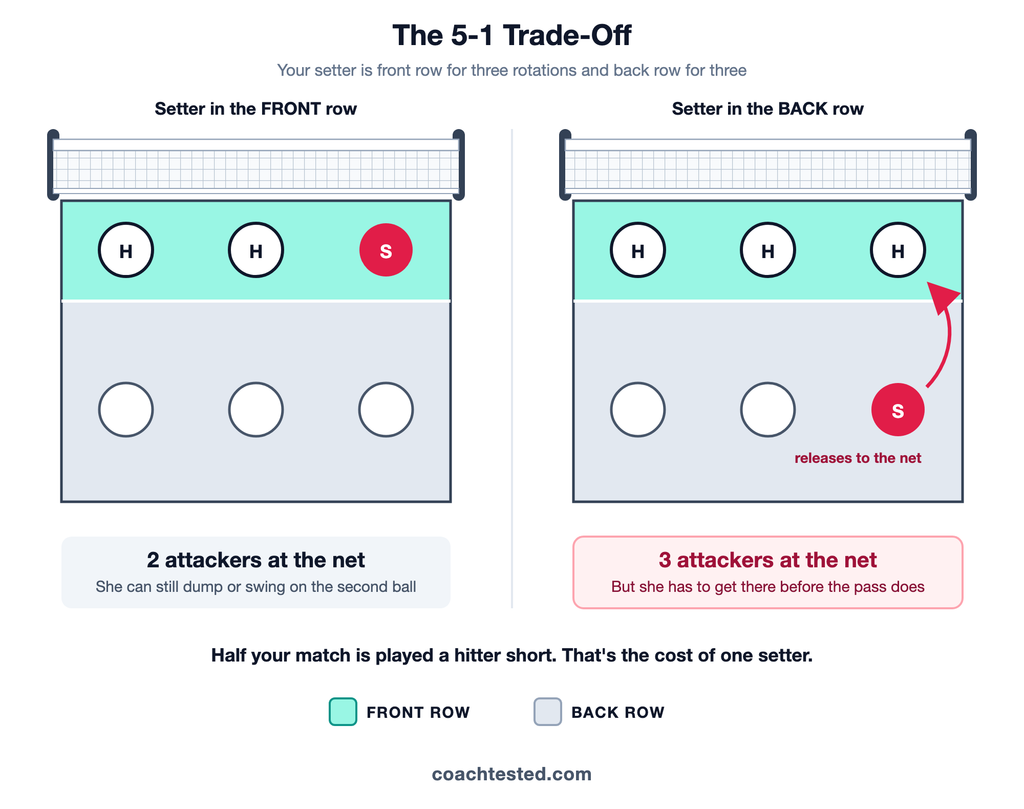
In a 5-1, one setter sets in all six rotations. She’s front row for three of them and back row for three, and she sets every ball either way.
Three things have to be true at once.
Your setter has to release from the back row. She starts in a legal position, and the moment the serve is contacted she runs to the setting spot near the right front. If she’s late, the ball is already gone.
She can’t be a passer. She’s busy. So you’re passing serve receive with two or three players instead of four, and hiding her out of the passing lanes takes deliberate arranging in every rotation.
Your passing has to be good enough to reach her. If the first ball sails to middle back or off the court, your setter is chasing. If you don’t have a libero, this is the requirement that gets harder. You’re a passer short and your middle is taking serve. Running a 5-1 Without a Libero covers what changes and what it costs.
Stack those up and you can see why it’s hard. A 5-1 doesn’t just ask your setter to be great. It asks your whole team to be consistent.
There’s a fourth thing, too: she touches the second ball on every rally, in all six rotations, for the whole match. Coaches running a young setter in a 5-1 often end up pulling her for a rotation just to let her breathe.
The Question that Decides It
Ask this:
Can one player on my roster set a hittable ball to a hitter from anywhere on the court, including when she starts in the back row, more often than not?
If yes, a 5-1 is on the table.
If no, and for most C teams, B teams, and first-year programs the answer is no, then running one means your best athlete spends every rally chasing a ball she can’t reach while five other players stand and watch.
One more filter. If that player is also the only person who can pass, or your best defender, you may need her somewhere else. A setter who’s your defensive anchor is a setter you can’t afford to lock into the setting job.
Another cost: for the three rotations your setter is front row, she is also your right-side blocker. If she can’t get off the ground there, the other team’s outside is swinging against one blocker or none, and a decent opposing coach will find that inside a set. It doesn’t rule out a 5-1, but it gets costly when kids start hitting hard.
The Development Argument
This is the strongest case against running a 5-1 rotation early: a 5-1 means one kid learns to set and nobody else really does — at exactly the age when athletes should be touching every skill.
Some programs act on this and won’t put a team in a 5-1 until 15s or 16s. Fifteen or sixteen is also the age the American Academy of Pediatrics gives for delaying single-sport specialization, on the grounds that narrowing a young athlete too early raises injury and burnout risk without improving her odds of still playing later.
The AAP is describing kids who play one sport all year, not kids who play one position. But the reasoning is similar.
There’s a practical version of this argument too. Setters get hurt. Setters get sick. Setters move. A program where four players can pass a decent ball to a target is more durable than one built around a single specialist.
And there’s the coach who has your players next year. The kid who learned to set in seventh grade is a resource for someone else’s roster in ninth.
The Case for Running One Anyway
Plenty of experienced coaches disagree with waiting and will get into a 5-1 as soon as they have the personnel who can do it.
If you’re building a program from nothing, teaching the system you’ll finish with saves you from teaching it twice. Coaches who start seventh graders in a 5-1 do a favor to coaches down the road.
There’s also a talent version of the argument. It depends on your gym, not the calendar. A team with strong hitters and exactly one real setter is a 5-1 team, whatever grade it is.
Above a certain level, almost nobody runs a 4-2. Every season a player spends in one is a season she isn’t spending on the system she’ll eventually play.
The 5-1 decision is about which roster you happen to be holding.
What Most Teams Should Do Instead
Start with a 4-2. The setter is always in the front row, she doesn’t pass, she never needs to dodge anybody en route from the back row, and there are fewer ways for it to go wrong. It’s also the version you can coach while you’re still learning the sport, which matters if you feel like you are juggling a lot at once. There’s a scoreboard argument too, at this age: you’ll win points off the other bench’s rotation faults while they wrestle with something more complicated.
The 4-2’s virtue is simplicity. You’re choosing the system with the fewest ways to fall apart while everybody learns the basics of playing volleyball.
How to Run a 4-2 Volleyball Rotation
If you have two setters who are identical twins, and they have similar setting styles, you may want to think about a 6-2. I jest, but seriously, if you actually have identical twin setters, it might work well!
If you already have two setters who can genuinely set, a 6-2 is worth a look. I’d still start most teams in a 4-2, because a 6-2 needs four players you trust — two setters and two right sides — and most middle school rosters have one of each.
“But the 8th grade team runs a 5-1”
If the team your players feed into runs a 5-1, there’s an argument for exposure now, so they arrive knowing the shape of it. Program alignment is good, but as a coach I would rather inherit players with good fundamentals than players with system knowledge.
Development Over Winning
A seventh grade team is a learning team. Whatever you run, you’re likely to lose some matches this season, and the system won’t change that much. A better metric is how many of your players are still playing in two years.
If you pick the rotation that gets more athletes touching more skills, you’ll be right, even if the scoreboard doesn’t go your way.
The Decision in 4 questions
Run a 5-1 only if you can answer yes to all four:
- One player can consistently deliver a hittable ball from anywhere, including out of the back row
- Your passers can get the first ball to a target most of the time
- That setter isn’t the only player holding up your defense or your serve receive
- You understand the system well enough to fix it mid-match
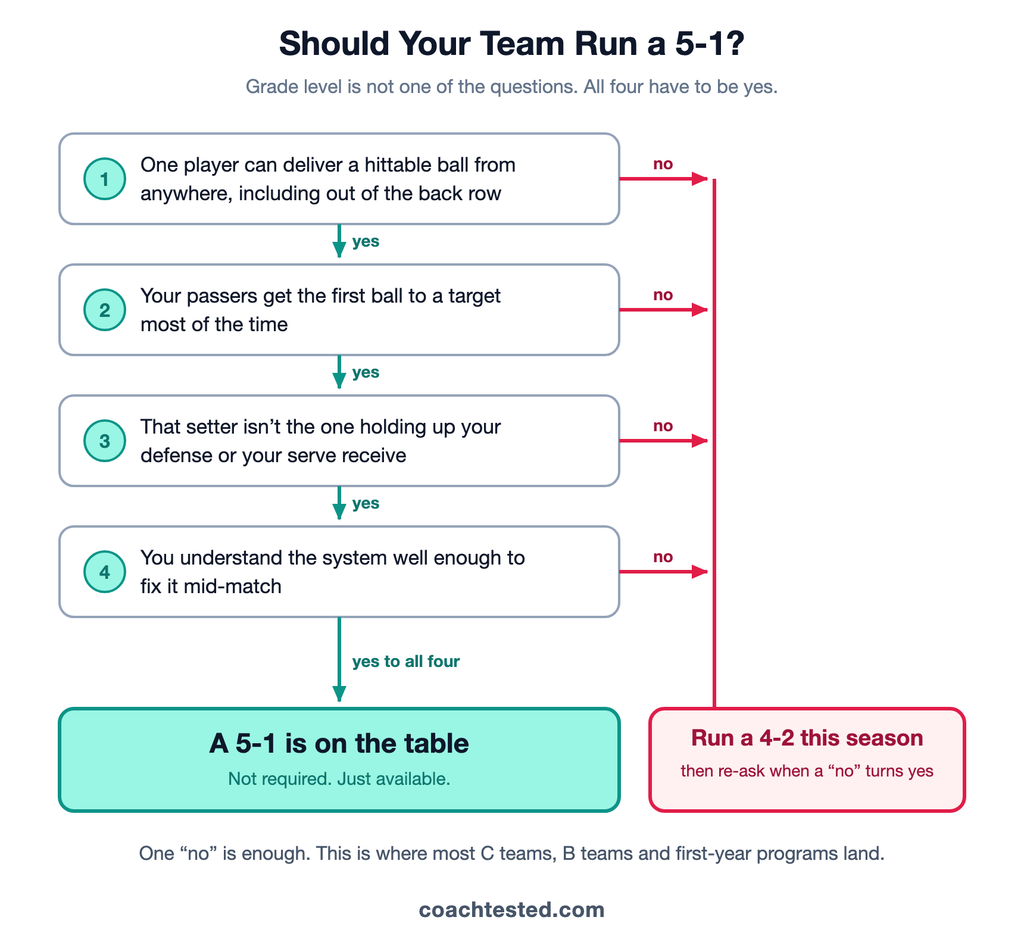
If you answered no to any of them, run a 4-2 this season and build toward consistency.

2 Comments
Comments are closed.